BLOG
Searching for a 1 Deck 1 Tray Gas Oven? Verify Capacity, Gas Supply and Installation First
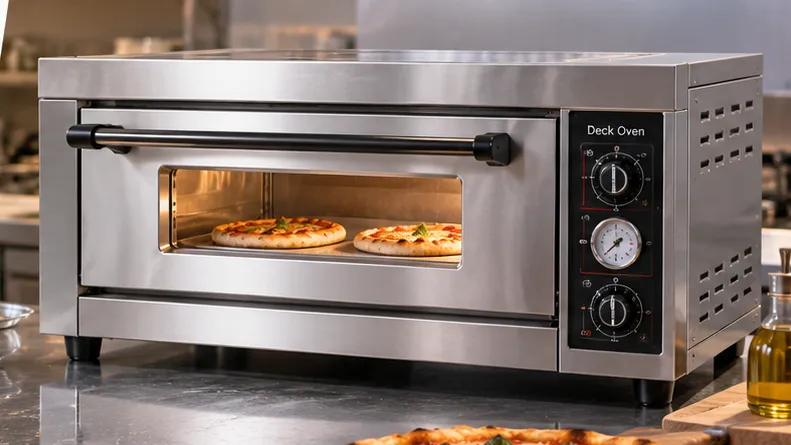
Buyers searching for a 1 deck 1 tray gas oven should verify the actual supplier configuration before requesting a final quotation. Jinmaide’s current verified Gas Deck Oven data does not list a one-layer/one-tray model; the smallest documented gas configuration is one layer with two trays. That single-deck/two-tray model is listed at 1330 × 840 × 650 mm, 220V, 100W, LPG, 2.8 kPa gas pressure and 0.28 kg/h gas consumption. Therefore, a “1 tray” search phrase should be treated as a capacity request to clarify—not as proof that the supplier currently offers a one-tray gas model.
Turn the Search Phrase Into a Real Equipment Configuration
Search behavior and product catalogs do not always use the same language. A buyer may type “1 deck 1 tray gas oven” because the business needs a compact gas deck oven, because only one tray is used per batch, or because the buyer assumes one deck contains one tray. None of those assumptions should be carried directly into the purchase order.
The first RFQ question should be: what is the smallest verified single-deck gas configuration, and how many trays does it actually hold? In Jinmaide’s current product data, the answer is one layer with two trays. That means the buyer must decide whether a two-tray chamber is acceptable or whether a true one-tray gas model is a mandatory project requirement that needs separate supplier confirmation.
Fact-safety boundary: Jinmaide’s supplied product data verifies a one-layer/two-tray Gas Deck Oven, not a one-layer/one-tray gas model. Do not infer a one-tray gas specification by halving the dimensions, gas consumption, weight or price of the two-tray model.
A 1 Deck Gas Oven Still Needs Tray and Chamber Verification
The keyword 1 deck gas oven confirms only the number of baking layers a buyer wants. It does not define tray count, tray dimensions, chamber size or production capacity. A single deck can contain more than one tray position, which is exactly what the verified Jinmaide gas product data shows.
This matters because bakery capacity depends on how the chamber is used. A two-tray single deck can support two trays in the same baking chamber, but that does not automatically mean every bakery should load both positions all the time. The product mix, tray size, batch sequence and recipe consistency still determine whether the configuration is operationally suitable.
Before comparing a commercial gas deck oven quotation, the buyer should provide the actual tray dimensions used in production. The current Jinmaide gas product table does not state tray size, so that detail should be returned by the supplier rather than guessed from the external dimensions.
Use the Verified Single-Deck Gas Model as a Reference, Not a Substitute
Jinmaide lists the computer-controlled JMD-KXD1-2 and instrument-controlled JMD-KXD1-2A as one-layer/two-tray gas deck ovens. Both are listed at:
- 1330 × 840 × 650 mm;
- 220V;
- 100W electrical power;
- LPG;
- 2.8 kPa gas pressure;
- 0.28 kg/h gas consumption;
- 102 kg;
- 0–400℃ temperature control range.
These values are useful for a buyer evaluating a gas oven for bakery use because they show the actual utility profile of a verified single-deck model. They should not be repurposed as specifications for an unverified one-tray version.
If a buyer’s project strictly requires one tray, the RFQ should state that requirement and ask Jinmaide whether another configuration is available. The supplier response should identify the actual model, tray capacity, dimensions, gas data and control type. This creates an auditable specification instead of a chain of assumptions based on a search phrase.
Gas Heating Does Not Mean “No Electricity Required”
One of the more useful purchasing details in Jinmaide’s verified gas deck oven data is the electrical requirement. The one-layer/two-tray gas models are listed at 220V and 100W. This shows why a commercial gas oven for bakery projects still needs an electrical connection for controls and related electrical functions even though the primary heat source is gas.
For site planning, the buyer should therefore confirm both utility interfaces:
- the gas type and required supply condition;
- the electrical voltage and connection for the selected control system.
Ignoring the second interface can delay installation. A kitchen may have an LPG supply point but no convenient electrical outlet at the intended oven position. The equipment may be described as “gas,” yet it still cannot be commissioned without its specified control power.
Confirm the Gas Category and Pressure Before Comparing Quotes
For the verified Jinmaide one-layer/two-tray models, the listed gas category is LPG and the listed gas pressure is 2.8 kPa. These are model-specific product facts. A buyer using another fuel arrangement should not assume compatibility. The correct step is to send the intended gas type and site supply information in the RFQ and ask the supplier to confirm whether the selected model is suitable.
This is especially important for international procurement. A bakery gas oven can be installed in markets with different local gas systems, connector practices and safety regulations. The equipment data can define the oven’s requirement, but local qualified installers and local regulations define how the supply is connected and approved.
The product page does not provide a universal installation procedure or local compliance distances, so those details should not be invented in the article or assumed during procurement.
Gas Consumption Is a Model Number, Not a One-Tray Estimate
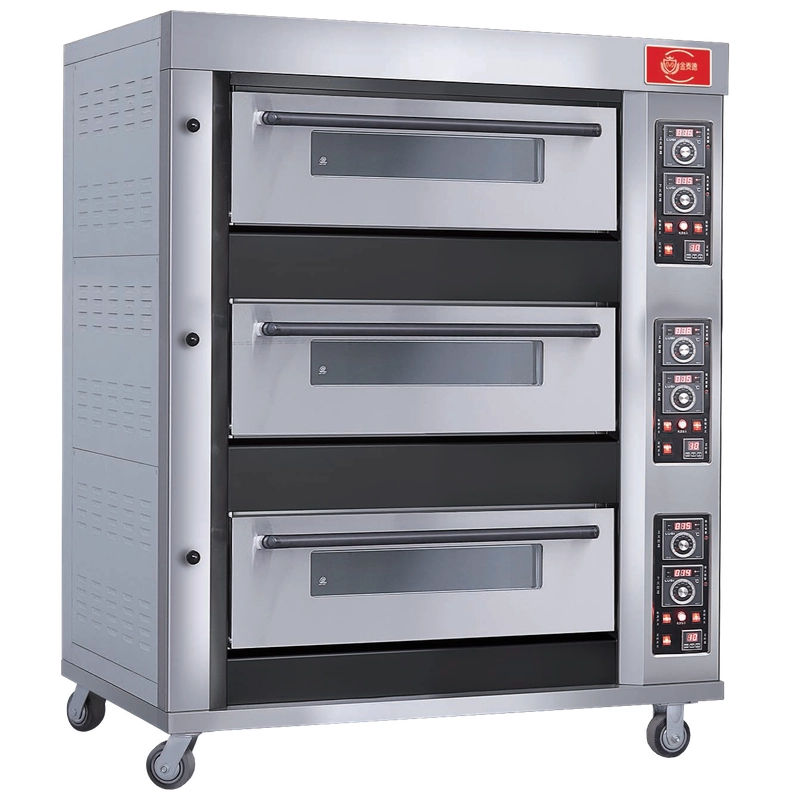
The verified one-layer/two-tray model is listed at 0.28 kg/h LPG consumption. Higher-capacity gas deck ovens in the same product family have higher listed consumption values. This makes gas consumption useful for comparing verified configurations and for estimating operating demand.
However, it would be incorrect to turn 0.28 kg/h into a one-tray estimate by dividing it in half. Burner design, chamber volume, insulation, heat recovery and control logic do not necessarily scale linearly with tray count. If a true one-tray gas model is requested, the gas consumption must come from that model’s own specification.
This is the right way to answer a common long-tail buying question such as gas deck oven gas consumption: first identify the exact model, then use the supplier’s model-specific gas data. Do not estimate from a different tray configuration.
External Dimensions Must Be Checked Against the Kitchen Layout
The verified one-layer/two-tray Gas Deck Oven is listed at 1330 × 840 × 650 mm. Those dimensions matter when the buyer is searching for a compact or single-deck solution, but they do not define the complete installation area. Space is also needed for loading, door operation, gas and electrical connections, cleaning access and any local installation clearances.
The Jinmaide product data does not publish those clearances, so the safe procurement approach is to provide the kitchen layout and ask the supplier for model-specific connection information. A qualified local installer should then review the proposed position against local requirements.
This is more reliable than using an internet search for a “small” commercial gas bakery oven and assuming that the external body dimensions alone determine whether the machine will fit.
Tray Count Should Be Matched to the Bakery Workflow
If the buyer originally searched for one tray because production volume is low, a one-layer/two-tray gas oven may still be relevant—but only if the larger tray capacity does not create an operational problem. The bakery can evaluate whether the extra tray position supports peak demand, parallel products or future growth, or whether it creates unnecessary footprint and utility demand.
If one tray is a hard process limit because of available trays, product batch size or counter space, then a two-tray chamber should not be accepted merely because it is the closest catalog model. The RFQ needs to preserve that requirement and request a supported alternative.
The decision therefore follows this sequence:
- define the tray format and maximum trays per batch;
- define the number of decks required;
- define the site gas and electrical utilities;
- identify the supplier’s actual model that meets those conditions;
- compare dimensions, consumption, control and installation scope.
Do Not Reuse Gas-vs-Electric or Control-System Comparisons as the Main Decision
Jinmaide already has published content comparing gas and electric deck ovens and comparing computer-controlled with instrument-controlled ovens. For a buyer searching for a 1 deck 1 tray gas oven, those are secondary questions. The immediate decision is configuration verification: does the supplier actually offer the requested tray/deck arrangement, and what utilities does the quoted model require?
Control type can still be confirmed after the physical configuration is matched. The verified one-layer/two-tray gas range includes both computer-controlled and instrument-controlled versions with the same listed size, voltage, electrical power, gas category, gas pressure, gas consumption, weight and temperature range. That makes control selection a workflow decision rather than a substitute for model matching.
RFQ Checklist for a Buyer Searching for a 1 Deck 1 Tray Gas Oven
| RFQ Item | Buyer Should State | Supplier Should Confirm |
|---|---|---|
| Deck count | One deck required | Actual number of baking chambers |
| Tray count | One tray requested or maximum acceptable trays | Actual tray positions in the offered model |
| Tray size | Existing tray dimensions if fixed | Compatible tray dimensions |
| Gas type | Site fuel type | Supported gas category for the exact model |
| Gas pressure | Site supply data if available | Required pressure for the exact model |
| Gas consumption | No estimate required | Model-specific consumption |
| Electrical supply | Available site voltage | Voltage/power required for controls |
| Dimensions | Maximum available installation space | Machine dimensions and connection information |
| Control | Computer or instrument preference if relevant | Available version for the matched configuration |
Use the Verified Product Page to Convert Search Intent Into a Quoteable Model
Buyers can first review Jinmaide’s Commercial Baking Ovens category and the verified Gas Deck Oven product page. The current product data gives a concrete reference for one-deck gas equipment, including the one-layer/two-tray models and their listed LPG, pressure, consumption, voltage and dimensions.
If the project still requires a true one-tray gas configuration, send that requirement through the Contact Us page and ask for a model-specific response. The supplier should return the actual tray arrangement and technical data rather than asking the buyer to infer a one-tray version from the two-tray model.
That is the practical SEO and procurement answer behind the keyword: a search term can start product discovery, but only a verified configuration can become a purchase specification.