BLOG
Steam Injection in Commercial Bakery Ovens: How Should Buyers Specify Humidity Control?
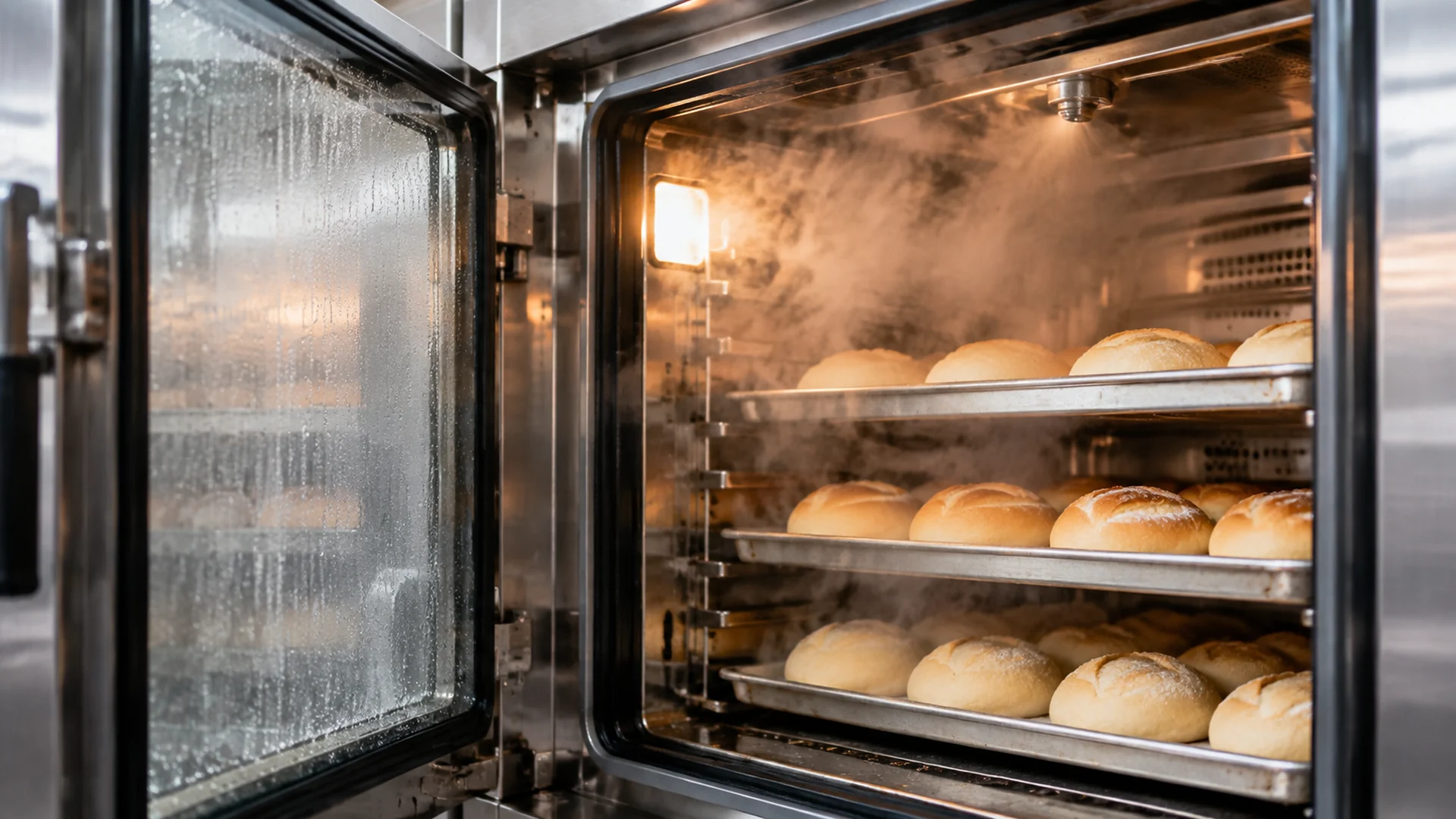
Steam injection can influence surface moisture, heat transfer and crust formation during baking, but steam injection, steam quantity and chamber relative humidity are not interchangeable specifications. A timer-controlled steam function defines when or how long steam is introduced. A controlled steam output describes the delivery of steam. A relative-humidity control system requires a defined measurement and control arrangement.
For buyers evaluating commercial bakery ovens, the important question is not simply whether the equipment has a steam function. It is what the oven can actually control, what it measures and how the function can be verified under the intended baking conditions.
What Does Steam Injection Change During Baking?
Steam Condensation and Heat Transfer
When steam enters a cooler baking chamber or contacts a cooler dough surface, some of it condenses and releases latent heat. The resulting surface moisture and heat transfer can influence the early stages of baking.
Steam also changes the moisture conditions around the product. The effects depend on the amount introduced, the timing, chamber conditions, airflow, product formulation and the stage of the baking cycle. The same steam programme can therefore produce different results when the product, loading pattern or oven configuration changes.
A study by Le-Bail and colleagues examined steam injection during bread baking under specific experimental conditions. It investigated how steam quantity influenced baking behavior and bread characteristics. Those findings support the importance of steam conditions, but the quantities used in that experiment should not be treated as universal settings for every commercial bakery oven.
Surface Moisture, Crust Formation and Product Expansion
Steam during the early baking stage can delay surface drying and affect how the crust develops. The balance between moisture, heat transfer and expansion depends on the dough, the oven’s thermal conditions and the baking programme.
More steam is not automatically better. Excessive or poorly timed steam may not provide the intended result for a particular product. A buyer should therefore define the desired baking outcome rather than specify an arbitrary steam duration without reference to the recipe and equipment.
The appropriate verification might include crust appearance, expansion, surface condition, moisture loss or another product-specific quality measure. The relevant measure depends on what the bakery needs to reproduce consistently.
Are Steam Time, Steam Quantity and Humidity Setpoints the Same?
These terms describe different aspects of the equipment’s operation.
| Function or specification | What it describes | What buyers should verify |
|---|---|---|
| Timed steam injection | The time or programme stage during which steam is introduced | Adjustable duration, programme sequence and operating limits |
| Steam output control | A method of adjusting or specifying steam delivery | Control method, available output range and supporting specifications |
| Humidity measurement | Measurement of humidity at a defined location and under stated conditions | Sensor type, measurement location, range and calibration information |
| Relative-humidity feedback control | A system that uses humidity measurement to regulate operation against a setpoint | Sensor feedback, control logic, setpoint range and response behavior |
A controller that allows an operator to set steam duration does not, by itself, demonstrate that the oven measures or controls relative humidity. Similarly, a steam generator’s rated output does not establish the effective steam quantity reaching the baking chamber under every operating condition.
The distinction matters because the chamber is a changing environment. Steam can condense on cooler surfaces, mix with the circulating air and leave through the exhaust. The amount injected is therefore not a direct measurement of the chamber’s relative humidity.
When reviewing a commercial baking oven with steam, ask the supplier to identify the actual function available on the quoted model. If the required process depends on a humidity setpoint, the specification should identify the measurement and feedback system that supports it.
How Do Oven Design and Baking Conditions Affect Humidity?
Steam Distribution and Airflow
Steam distribution depends on how steam enters the chamber and mixes with the circulating air. The position of the injection point, airflow paths, chamber geometry and exhaust arrangement can affect the conditions experienced by products at different locations.
A chamber-wide humidity value, if available, also needs a defined measurement location. One sensor reading cannot automatically establish that every tray experiences the same local moisture conditions.
For this reason, buyers should distinguish the steam-generation system from the distribution system. The ability to produce steam does not prove that it is distributed uniformly under all loading conditions.
Oven Loading, Exhaust and Moisture Loss
The amount and arrangement of product in the oven affect the chamber’s thermal and moisture balance. Product surfaces absorb heat and exchange moisture with the surrounding air. Loading can also alter airflow paths and the recovery behavior after the door is opened.
Exhaust settings influence how quickly humid air leaves the chamber. If steam injection and exhaust are not considered together, the same nominal injection time may not create the same chamber conditions.
This can be assessed with a controlled comparison:
- Use the same product formulation and loading arrangement.
- Keep the relevant temperature programme consistent.
- Record the steam programme and any available humidity data.
- Compare the same product-quality indicators across trials.
- Document changes in loading, door opening or exhaust settings.
This approach helps distinguish a change in the steam function from a change caused by the production process. It does not require the buyer to assume that a particular humidity value is appropriate for every product.
How Should Buyers Specify Steam and Humidity Functions?
Confirm What the Controller Actually Measures
A product description may mention steam injection, steam humidification or humidity control. These phrases should be tied to the actual functions documented for the specific model.
If the oven provides timed steam injection, confirm the available timing settings and programme stages. If it adjusts steam output, establish how that output is controlled and which specifications define the adjustment. If it claims closed-loop relative-humidity control, request the relevant sensor and control-system information.
A useful specification review should identify:
- Whether steam is generated within the oven or supplied from another system.
- How steam injection is initiated and controlled.
- Which parameters the operator can set.
- Whether relative humidity is measured or merely inferred.
- Whether a sensor feeds back into the control logic.
- The stated operating range and limitations of the function.
Do not assume that every steam oven has a humidity sensor or that a steam function provides the same control capability across different product families.
Check Steam Capacity and the Injection Sequence
Steam capacity and programme control should be evaluated against the intended production process. A rated steam-generation capacity, where specified, describes a component or system capability under its stated conditions. It does not necessarily represent the steam that condenses on the product or the resulting chamber humidity.
The injection sequence also matters. A short steam pulse at the start of a cycle is different from repeated injection or steam addition at a later stage. Buyers should verify which sequences are available and whether the controls can reproduce the required programme.
Jinmaid’s rotary hot air circulation electric oven is described with a steam humidification function. Its commercial multi-purpose steam oven is presented as supporting steaming, baking and combined steam-baking modes.
These product descriptions establish the relevant equipment categories, but they do not by themselves prove that every model offers a measured relative-humidity setpoint or closed-loop humidity control. The exact controller, steam arrangement and available settings should be confirmed for the model being considered.
How Can Steam Performance Be Verified Before Purchase?
A functional check and a baking-quality test answer different questions. A functional check can establish that a steam programme runs as specified. A baking-quality test examines whether the equipment produces the required result under the intended conditions.
Define the Product and Baking Conditions
Before comparing settings, document the product, recipe, batch size, tray arrangement, temperature programme and target result. These variables should remain consistent during a controlled comparison unless the purpose of the test is to investigate one of them.
The test should also record the steam settings actually used and the data the oven can provide. If humidity is measured, identify the measurement location and the sensor information available. If the oven only reports steam duration, record that as a programme setting rather than as measured relative humidity.
Distinguish Functional Verification from Product Quality
A useful pre-purchase evaluation can examine:
- Whether the steam function can be initiated and repeated as documented.
- Whether the selected programme settings can be reproduced under the intended operating conditions.
- Whether temperature and any available humidity measurements can be recorded consistently.
- Whether the finished product meets the agreed quality criteria, such as surface appearance, expansion, texture or moisture loss.
- Whether the result remains consistent across representative batches and loading conditions.
The acceptance criteria should be agreed before the test. A successful steam-function check does not automatically establish baking quality, and a satisfactory product from one trial does not establish repeatability across all operating conditions.
If the oven does not measure relative humidity, the evaluation can still assess the documented steam function and the resulting product quality. It should not, however, report an unmeasured humidity value as a verified result.
Which Jinmaid Oven Configuration Fits the Required Steam Function?
The appropriate model depends on the required baking process and the steam capability documented for that model. A rotary hot air circulation oven and a multipurpose steam oven may serve different production requirements, so their product names alone do not establish that their steam functions are equivalent.
Before selecting a configuration, confirm the products and recipes the oven must handle; whether the process requires timed steam injection, adjustable steam output or measured humidity feedback; the available temperature and steam programme settings; tray or rack configuration and expected loading; and the information available for verifying steam operation and finished-product quality.
Jinmaid’s rotary hot air circulation electric oven and commercial multi-purpose steam oven provide two relevant product paths for further specification review. The final selection should be based on the confirmed functions and configuration of the quoted model, rather than assuming that all equipment described as a steam oven supports the same humidity-control capabilities.
For a project requiring a specific steam programme or humidity-related function, contact Jinmaid with the intended product, recipe, batch size and required control behavior. These details help establish which specifications and verification methods are relevant to the application.
References
- Le-Bail, A., et al. Research on steam injection and bread baking, Journal of Food Engineering. DOI: 10.1016/j.jfoodeng.2011.03.001.
- Jinmaid. Rotary Hot Air Circulation Electric Oven. Product information.
- Jinmaid. Commercial Multi-Purpose Steam Oven. Product information.