BLOG
1 Deck 1 Tray Electric Oven: How to Match Capacity, Power and Bakery Output
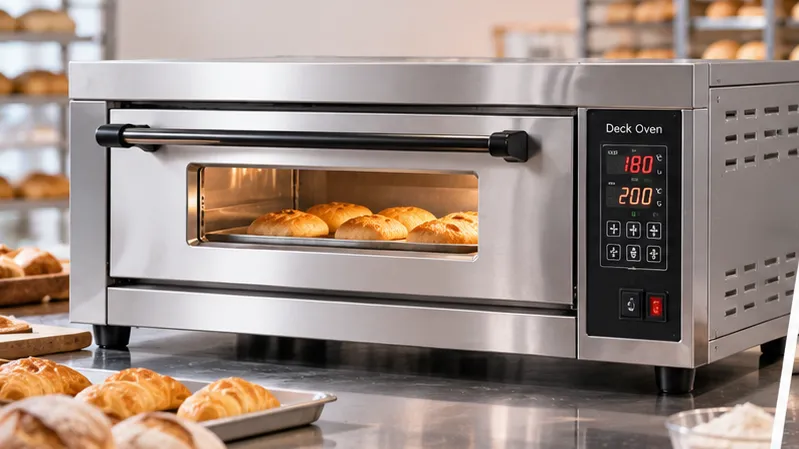
A 1 deck 1 tray electric oven is a practical choice only when one tray per baking cycle matches the bakery’s real batch size, electrical supply and loading rhythm. Jinmaide’s verified economical electric deck oven range includes two one-layer/one-tray models: JMD-KXD1-1A with computer control and JMD-KXD1-1 with instrument control. Both are listed at 920 × 605 × 490 mm, 220V, 3.2 kW, 41 kg and 10 kg/h reference output. The important purchasing question is not whether “one tray” sounds compact; it is whether the tray workflow, cycle frequency, power connection and required temperature range fit the actual bakery process.
What Does “1 Deck 1 Tray” Mean in a Commercial Electric Deck Oven?
In a deck-oven configuration, one deck means one baking chamber or layer. One tray means that the verified configuration is designed around one tray position in that deck. This wording is useful for screening equipment, but it does not describe the full bakery capacity by itself. A buyer still needs to know the tray format used in production, the number of pieces loaded per tray, the baking cycle, the number of batches per hour and the product changeover pattern.
This is why buyers searching for a 1 deck electric oven should not compare machines only by external size. The same “single deck” label can represent different tray capacities, chamber sizes, electrical loads and control systems. The line item becomes quoteable only after the buyer connects the deck/tray configuration to an actual production task.
Verified product boundary: Jinmaide’s Economical Electric Deck Oven page lists true one-layer/one-tray models. The page does not state the exact tray dimensions for those models, so tray size should be confirmed before purchase rather than inferred from the oven’s external dimensions.
Start With Tray Loading, Not the Oven’s External Dimensions
A small oven footprint can be useful in a compact bakery, café, hotel prep area or restaurant kitchen, but footprint alone does not determine productive capacity. The better starting point is the tray that already exists in the bakery workflow. Record its dimensions, the number of products placed on it, the average product weight and the normal baking time. Then check whether the proposed oven accepts that tray or whether the bakery would need a new tray standard.
For an electric deck oven for bakery use, a practical capacity estimate can be structured as:
pieces per tray × trays per batch × completed batches per operating hour = practical hourly pieces
This is more useful than assuming that one tray automatically means low output or that two trays automatically double useful production. Actual throughput also depends on loading and unloading time, preheating, recipe changes, recovery between batches and whether products can share the same temperature profile.
Jinmaide lists 10 kg/h as the reference output for both one-layer/one-tray economical electric models. That figure is useful for comparing configurations inside the same product family, but it should not be treated as a guaranteed output for every bread, cake, pastry or pizza product. A buyer should translate the reference output into the bakery’s own product weight and cycle data.
220V and 3.2 kW Must Match the Site Before the Oven Is Ordered
The verified one-tray models are listed at 220V and 3.2 kW. That makes electrical verification one of the earliest RFQ steps. A bakery should confirm the actual site voltage, frequency, circuit capacity and connection requirements before approving the machine. The product table provides the equipment voltage and power, but it does not replace a site electrician’s assessment of the branch circuit, plug/socket arrangement or local electrical requirements.
For buyers searching for a commercial electric oven for bakery use, the useful comparison is not simply “electric versus gas.” The decision is whether the available electrical infrastructure can support the selected oven without an unplanned panel upgrade, cable change or relocation of other equipment.
A single one-tray unit may fit a 220V site more easily than a larger multi-deck model, but that should be verified from the selected model. Within Jinmaide’s economical range, electrical demand increases as deck/tray capacity increases. For example, the listed two-layer/two-tray configuration uses 6.4 kW, while the one-layer/two-tray configuration is listed at 6.6 kW. This illustrates why tray count, deck count and electrical load should be reviewed together rather than as separate catalog fields.
Use the Listed Output to Screen Capacity, Then Check the Real Baking Cycle
A listed output number can help screen whether a machine is in the right capacity class. It cannot replace a production calculation. The one-layer/one-tray models are listed at 10 kg/h, while larger configurations in the same economical series are listed at higher reference outputs. That progression makes sense for initial equipment sizing, but a buyer still needs to map the oven to the real product mix.
Consider a bakery that runs small morning batches but has a short peak period before opening. A 1 tray electric oven capacity that looks sufficient across an eight-hour day may still be too small if most demand occurs in a two-hour window. Conversely, a larger oven can be unnecessary if products are baked to order and idle capacity would dominate the day.
The useful decision variables are:
- pieces or kilograms loaded per tray;
- baking time per recipe;
- loading and unloading time;
- number of peak-hour batches;
- number of recipes that need different settings;
- acceptable waiting time between batches;
- expected production growth.
These variables explain whether a one-tray configuration is truly a good fit for an electric oven for bakery business operations, rather than simply a lower-cost entry point.

Computer-Controlled and Instrument-Controlled Models Have Different Temperature Ranges
Jinmaide lists two control versions for the one-layer/one-tray economical electric oven. The computer-controlled JMD-KXD1-1A is listed with a 0–400℃ temperature control range. The instrument-controlled JMD-KXD1-1 is listed with a 0–300℃ range. Both share the same listed size, voltage, power, weight and reference output.
This difference matters because the control decision should be tied to recipes rather than to a preference for a more advanced-looking panel. If the bakery’s validated recipes operate within the lower range, the instrument-controlled version may still satisfy the process. If the product mix requires the higher listed range, that becomes a concrete reason to specify the computer-controlled model.
The product page also states that the economical series uses separate upper and lower temperature control, a timer alarm, digital temperature control, an observation window and other operating features. Those features can support repeatable deck-style baking, but the buyer should confirm which functions are included on the exact model being quoted.
When Is a 1 Deck 1 Tray Electric Oven Too Small?
A 1 deck 1 tray electric oven becomes a bottleneck when the bakery needs more simultaneous tray positions than the production schedule can tolerate. The warning signs are operational, not cosmetic: trays waiting for oven access, staff holding finished dough too long before baking, repeated recipe changeovers, or peak-hour orders exceeding the number of available cycles.
If one tray is insufficient, buyers have more than one scaling path. Jinmaide’s economical range includes a two-layer/two-tray configuration that keeps the 920 mm listed width while increasing height, and a one-layer/two-tray configuration with a wider body. Those two options solve different workflow problems. The first adds another deck vertically; the second expands same-deck tray capacity horizontally.
This distinction is useful for a small electric deck oven for bakery project because floor space and workflow do not always scale in the same direction. A narrow bakery may prefer vertical capacity. A bakery that wants two trays in the same chamber may accept a wider footprint. The buyer should compare available floor width, loading height and tray movement before choosing a capacity upgrade.
External Size Is Not the Same as Installation Space
The verified one-tray economical models are listed at 920 × 605 × 490 mm. Those are equipment dimensions, not a complete installation envelope. The site still needs room for door movement, safe access, electrical connection, loading/unloading and the working surface used to stage trays.
The product page does not provide installation clearances, so those distances should not be invented in an RFQ. Instead, buyers should send the room layout and ask the supplier to confirm the connection side and any model-specific installation requirements. Local electrical and fire-safety rules should also be checked by qualified local parties.
This is especially important in compact kitchens where the oven may technically fit the allocated footprint but interfere with tray handling or adjacent equipment during daily use.
How to Compare a One-Tray Oven With Larger Configurations
| Decision Item | 1 Layer / 1 Tray | What the Buyer Should Check |
|---|---|---|
| Verified models | JMD-KXD1-1A / JMD-KXD1-1 | Control version required for the recipe set |
| Listed dimensions | 920 × 605 × 490 mm | Actual kitchen layout and tray handling space |
| Listed voltage | 220V | Site voltage and electrical connection |
| Listed power | 3.2 kW | Circuit capacity and local installation requirement |
| Listed output | 10 kg/h | Real product weight, batch size and cycle time |
| Temperature range | 0–400℃ computer; 0–300℃ instrument | Recipe temperature requirement |
| Tray specification | One tray position verified; exact tray size not listed | Confirm tray dimensions before order |
The key purchasing point is the last column. A specification only becomes useful when it is connected to a bakery decision. For example, 3.2 kW matters because the site needs to supply it; 10 kg/h matters because the buyer needs to translate it into actual products; and one tray matters because that tray must fit the bakery’s workflow.
What to Send in the RFQ for a 1 Deck 1 Tray Electric Oven
A concise RFQ can prevent most capacity and utility misunderstandings. Send the bakery product list, required tray dimensions, target production by hour or peak period, available voltage, preferred control type, available installation space and quantity. If the exact tray size has not been standardized, state that openly and ask the supplier to return the compatible tray specification.
Buyers can review the broader Commercial Baking Ovens category and the verified Economical Electric Deck Oven product page before preparing the inquiry. Project-specific tray, utility and production requirements can then be submitted through the Contact Us page.
The right one-tray oven is therefore not simply the smallest available deck oven. It is the configuration that fits the tray standard, production peaks, electrical infrastructure and recipes without creating avoidable waiting time or unused capacity.