BLOG
How to Choose a Rotary Oven for Bakery Production
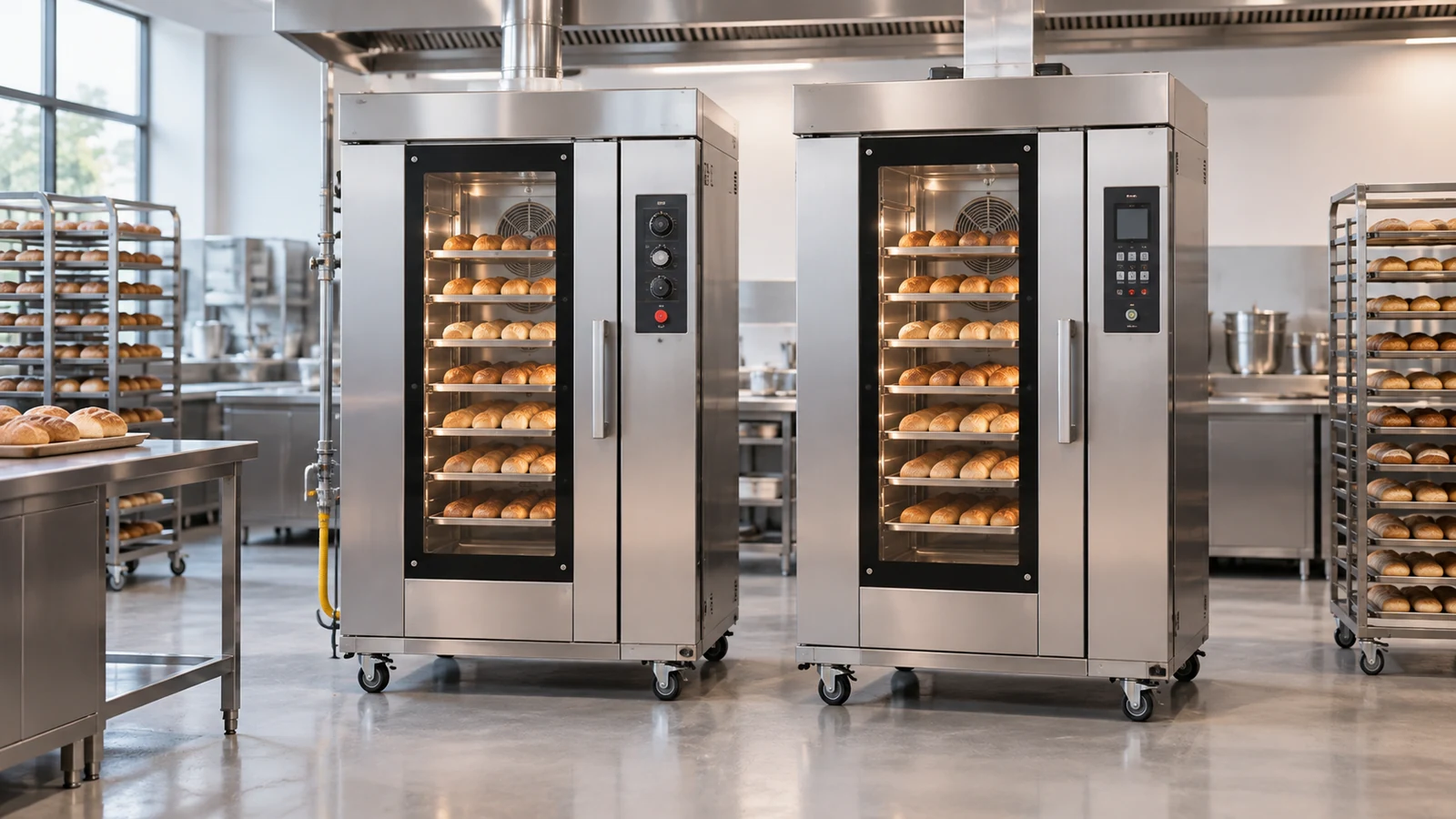
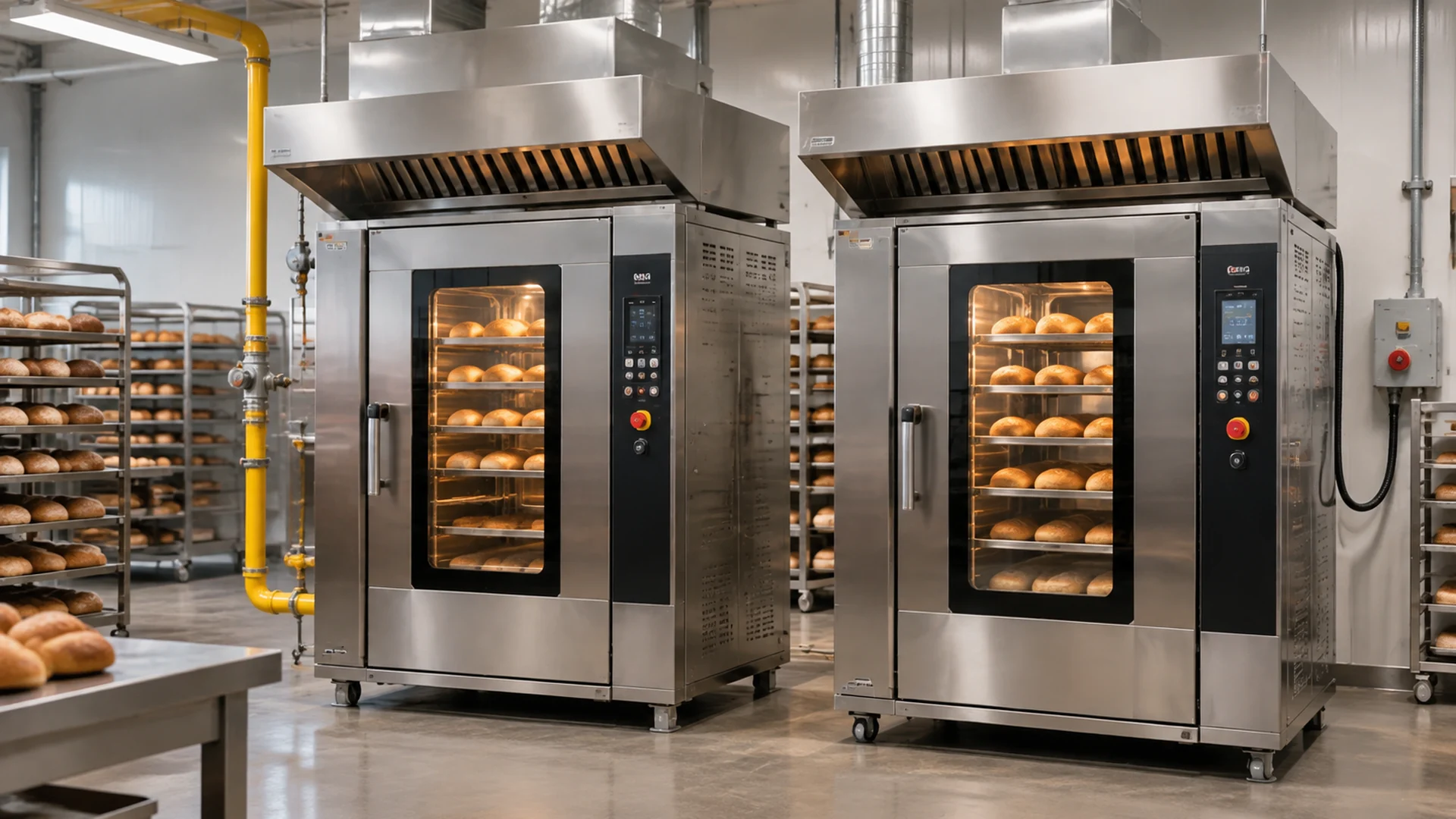
A rotary oven for bakery production combines circulating hot air with rotation of a loaded rack to support baking across multiple tray positions. It can suit bread, rolls and compatible pastry production, but real output depends on usable tray loading, recipe, full batch time and staff workflow—not the biggest tray count on a catalog page. Jinmaid publishes 5-, 8- and 10-tray electric rotary hot-air ovens designed around 40 × 60 × 3 cm trays, enabling a practical model comparison. These are nominal capacities, not guaranteed loaves or kilograms per hour. Before selecting a commercial rotary oven, estimate saleable units per batch and verify baking cycles, electrical supply, access clearance and steam requirements for the actual products.
What Is a Commercial Rotary Oven for Bakery Production?
A commercial rotary oven uses circulating hot air and rack rotation to bake products over multiple tray positions. It can be useful for bakeries planning repeated batches of bread, rolls and compatible pastries, but a tray count alone does not define real daily output. Bakery operators should evaluate recipes, usable loading, cycle timing and the equipment’s installation requirements together. Jinmaid’s published rotary hot-air electric oven range includes 5-, 8- and 10-tray configurations.
How Does a Rotary Hot-Air Oven Work?
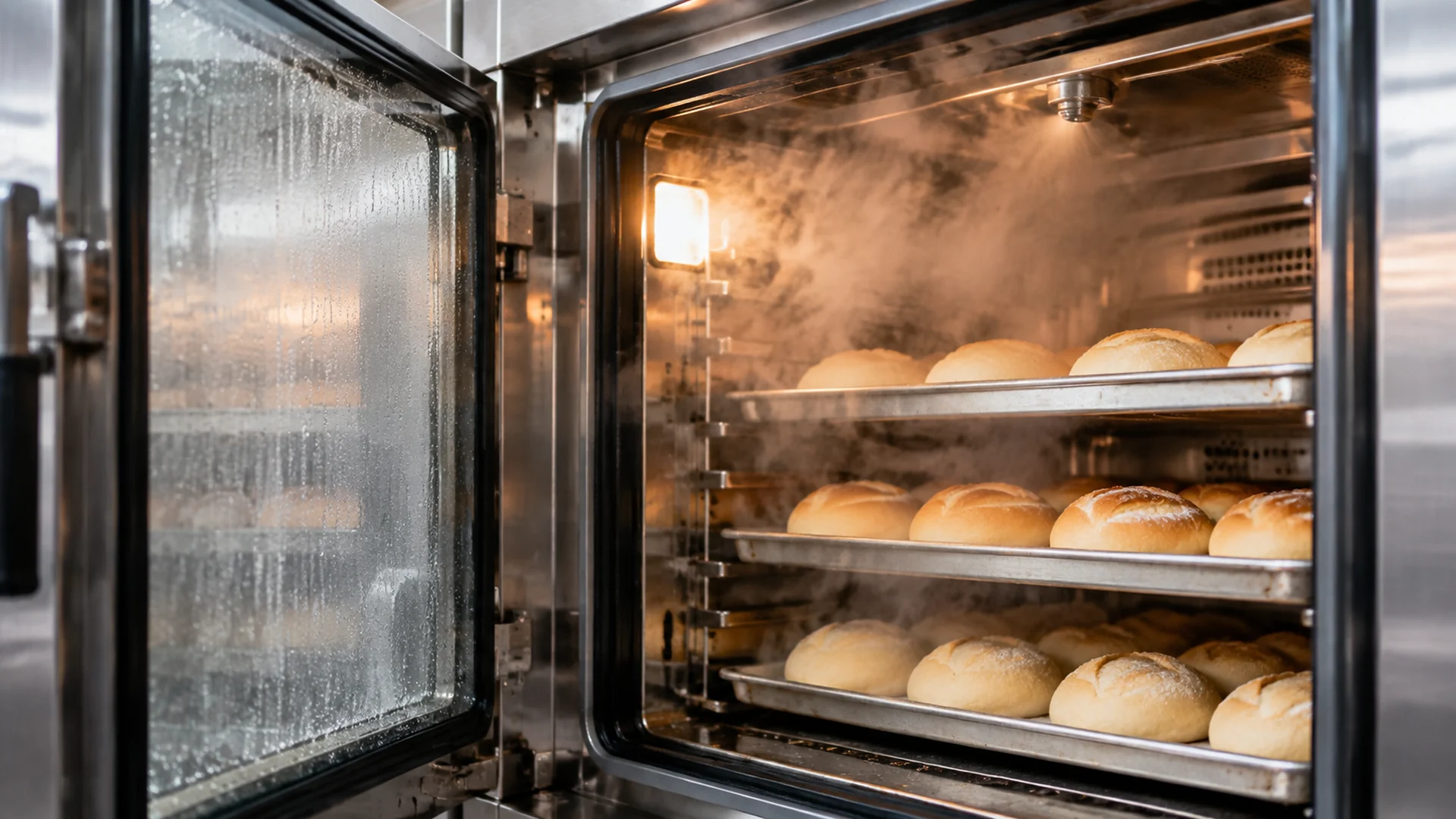
A rotary oven uses two related mechanisms: circulating hot air supplies heat to products in the chamber, while rotation moves the loaded rack through different positions relative to that airflow. The purpose is to manage exposure across the loaded rack; rotation alone cannot guarantee identical results at every tray position or with every product load. The recipe, fan arrangement, tray spacing, loading pattern and temperature control all matter.
Jinmaid’s rotary hot-air circulation electric oven page describes automatic rack rotation, an air-circulation system, a touch-screen controller and independent steam humidification. It also describes forward and reverse fan movement and mechanisms associated with access when the door is opened. These are statements for the published rotary series, not evidence that a different Jinmaid oven has the same mechanism.
A rotary hot-air oven is also not the same as a stationary deck oven: the latter may use separate baking decks and independently controlled heating conditions. A bakery should choose between them based on the desired products and production process, rather than treating the two structures as interchangeable.
What Are the Advantages and Limits of a Rotary Hot-Air Oven?
The combination of moving air and a rotating rack aims to distribute heating exposure across a batch. Multiple tray positions can make batch planning more straightforward where a bakery produces repeatable products. Yet even baking is not guaranteed by rotation alone: spacing, pan selection, loading, product moisture, airflow and control settings all affect results. A recipe trial is needed before drawing conclusions about uniformity or hourly output.
For a bakery comparing a rotary oven with a stationary deck oven, the main decision is product-specific baking requirements and production workflow, not which design is universally better. Deck ovens have a different chamber and heat-delivery arrangement; do not transfer specifications between designs.
What Does Tray Capacity Actually Tell You?
A 5-tray rotary oven provides five intended tray positions; an 8-tray unit provides eight, and a 10-tray unit ten. That is useful for planning, but a tray position is not a fixed number of finished products. A large loaf may require far more spacing than small rolls, and some pastries need room for expansion or specific airflow around the tray.
Jinmaid lists 40 × 60 × 3 cm baking trays for its JMD-FKD-5Z, JMD-FKD-8Z and JMD-FKD-10Z configurations. Buyers can first calculate how many acceptable items fit one tray for the exact recipe and layout. They then multiply that realistic per-tray count by the number of trays actually authorized for the process. If quality requires reducing the load, the lower usable number should drive the calculation.
| Published Jinmaid model | Tray count | Tray size | Rated power | Power supply |
|---|---|---|---|---|
| JMD-FKD-5Z | 5 | 40 × 60 × 3 cm | 9.4 kW | 380 V 3N~ |
| JMD-FKD-8Z | 8 | 40 × 60 × 3 cm | 18.4 kW | 380 V 3N~ |
| JMD-FKD-10Z | 10 | 40 × 60 × 3 cm | 18.4 kW | 380 V 3N~ |
These are the published values of the named electric models. The fact that the 8- and 10-tray models list the same rated power should not be interpreted as identical baking speed, electricity consumption per batch or achievable output.
How Do Batch Cycles Affect Real Bakery Output?
Turn the Production Target into Required Batches
Begin with a measurable target such as acceptable rolls during the morning production window. Determine the number of finished units you can load per tray without crowding, then the workable tray count for that recipe. The arithmetic is straightforward:
Required batches = target acceptable units ÷ acceptable units per batch (round the result up to a whole batch).
Illustrative calculation, not Jinmaid test data: suppose a bakery needs 720 rolls and a process trial confirms 12 acceptable rolls per tray. A five-tray load would hold 60 rolls per batch, requiring 12 batches; eight trays would hold 96 per batch, requiring 8 batches after rounding up; ten trays would hold 120 per batch, requiring 6 batches. The comparison is valid only if the recipe and rack spacing allow those tray loads and the oven delivers the required quality.
Include Loading, Baking, Recovery and Unloading
Do not multiply the tray count by a baking-time estimate and present the result as hourly capacity. A batch occupies more than the time displayed on the baking timer. Loading, door opening, handling, unloading and any required temperature recovery may reduce the batches completed in a shift. Preheating must be included in the schedule when the oven starts cold.
For a mixed-product bakery, oven access may also conflict with proofing readiness, mixing output and cooling space. An oven that can hold more trays may still sit idle if dough is not ready. Conversely, an undersized oven can create a queue even when upstream equipment has spare capacity. A practical batch plan therefore lists each product, usable trays, verified cycle, changeover and production window before equipment selection.
How to Estimate Rotary Oven Production Capacity Per Hour
A useful bakery oven production capacity calculation starts with saleable units, not nominal trays. Estimate units per batch = usable trays × acceptable units per tray. Then calculate the number of full batches that fit in the available production time after including loading, baking, unloading and required temperature recovery. The resulting estimated units per hour are a planning value, not a manufacturer-certified output rating.
For example, if a trial confirms 12 acceptable rolls per tray and six complete batches can be finished in the planned period, a five-tray arrangement would yield a planning figure of 360 rolls for that period (5 × 12 × 6). This illustration does not establish that the oven can complete six batches in one hour; actual cycle time must be verified separately.
Which Electrical and Space Requirements Need Checking?
Electric rotary ovens must match the electrical system at the installation site. Verify voltage, phase, frequency, protection, wiring and connection requirements from the applicable model documentation with a qualified installer. Rated power in kilowatts describes an electrical rating; it is not a direct measurement of energy consumed per batch. Actual consumption varies with heating duty, starting conditions, loading and process settings.
Jinmaid publishes the following external machine dimensions:
| Model | External dimensions (Wording as published: L × W × H) | Net weight |
|---|---|---|
| JMD-FKD-5Z | 105 × 125 × 173 cm | 262 kg |
| JMD-FKD-8Z | 105 × 125 × 186 cm | 335 kg |
| JMD-FKD-10Z | 105 × 125 × 186 cm | 378 kg |
External size is not an installation clearance. Allow separately for door movement, trays and rack handling, cleaning access, ventilation or exhaust provisions where required, and the route by which the oven reaches the kitchen. Check floor loading and local building and electrical requirements. The exact operating clearance should come from the appropriate installation manual, not a guessed margin added to the catalog size.
When Do Steam and Airflow Control Matter?
Different bakery products respond differently to humidity and airflow. Steam can be part of the early baking process for certain breads, while other products may benefit from different humidity and surface-drying conditions. Excessive airflow, densely packed trays or poorly timed steam may affect product appearance and texture. The correct settings depend on the recipe, not a universal “best” number.
Jinmaid describes independent steam humidification on the rotary hot-air electric oven series. That confirms the advertised feature, but the public page does not establish a steam output rate, humidity curve or validated recipe for a particular pastry or loaf. For project selection, buyers should ask which controls are accessible, how the system is maintained and which operating conditions are documented for the model.
During evaluation, compare the product requirements rather than the number of control buttons. If the bakery makes crusty bread and delicate pastries on different shifts, its trial or process plan should address each product’s acceptable results, compatible loading and changeover requirements separately.
How to Compare Jinmaid’s 5-, 8- and 10-Tray Rotary Ovens
Once the bakery has a production plan, compare three levels of information. First is the required usable tray capacity for the actual product. Second is the achievable batch cycle within the desired operating window. Third is the site’s power, floor space and service access. A nominally larger oven is not automatically the right model when the workflow, power supply or room layout cannot support it.
- Specify the food and tray loading. Provide product dimensions, planned spacing and the number of saleable units per tray.
- State the production window. Identify peak volume, product mix, target finish times and any planned shifts.
- Compare the published configurations. Check 5, 8 or 10 positions against the 40 × 60 × 3 cm tray format and verify model identification.
- Check the installation. Review rated power, 380 V 3N~ requirements, external dimensions, weight and manual-specific clearances.
- Validate the process. Confirm recipe-dependent baking time, steam needs, handling and acceptable finished-product quality before treating the batch plan as achievable capacity.
Readers comparing equipment types can browse Jinmaid’s commercial baking ovens category. However, specifications and features must be taken from the selected model’s product page, not transferred from another oven design.
What Should a Bakery Confirm Before Ordering a Commercial Rotary Oven?
Ask the oven supplier for the exact model and tray arrangement, rated electrical requirements, dimensions, loading instructions, steam-system documentation and installation guidance. Provide the bakery’s product mix, recipe-dependent cycle times, maximum saleable units per tray, planned batch window and door/access route. For Jinmaid’s three named models, use the published specifications as selection references and confirm the final quotation rather than inferring that all rotary ovens share the same controls or accessories.
Making the Final Rotary-Oven Decision
A rotary oven for bakery use should be selected on the basis of realistic tray loading and a complete production cycle, then checked against the installation site. Jinmaid’s 5-, 8- and 10-tray electric rotary ovens provide concrete configurations for that comparison; they are not certified output guarantees in loaves or kilograms per hour.
If you are assessing a specific model, discuss your bakery production requirements with Jinmaid and provide the products being baked, tray dimensions, acceptable units per batch, target daily volume, electrical service and site access dimensions.
Frequently Asked Questions
Is a 10-tray rotary oven always more productive than an 8-tray oven?
No. A 10-tray oven offers more nominal tray positions, but saleable output depends on allowed loading, recipe, baking and handling cycle, temperature recovery, quality acceptance and upstream production.
How do I estimate rotary oven output per hour?
Multiply usable trays by acceptable products per tray, then multiply by the number of complete batches that fit into the production period. Include loading, baking, unloading and recovery; verify the result using the actual recipe.
Can a Jinmaid 5-, 8- or 10-tray oven use the same baking trays?
The published JMD-FKD-5Z, JMD-FKD-8Z and JMD-FKD-10Z configurations list 40 × 60 × 3 cm trays. Confirm actual supplied trays and allowable loading for the exact order.
Do the 8-tray and 10-tray Jinmaid ovens use the same amount of energy?
Not established. Both published models show 18.4 kW rated power, but rated power is not measured energy consumption or output. Actual energy use depends on duty cycle, preheating, product load and operating settings.