BLOG
Which Gas-Powered Lift Fryer Configuration Fits the Buyer’s Application?
The right gas-powered lift fryer configuration depends on the menu, portion size, peak order pattern, required recovery, single- or dual-tank workflow, automatic basket-lifting need, available LPG or natural-gas supply, electrical control supply, oil-management routine, ventilation, floor space, and local installation requirements. Buyers looking for the best deep fryer for commercial use should not select by tank capacity alone. They should map real kitchen operations to one model, then verify gas, electrical, exhaust, cleaning, safety, and acceptance conditions before requesting a final quotation.
This guide follows the operating decision, from food and service pattern to installation evidence. It does not assume that the highest-capacity vat or the most automation is always better. A configuration is suitable when it delivers the required menu during peak periods without creating unnecessary oil volume, utility demand, cleaning work, or service complexity.
Begin With the Menu and Peak Service Pattern
List every core fried product, its portion weight, coating, frozen or fresh condition, target finish, and typical cook time. Fried chicken, French fries, dough products, spring rolls, pork chops, prawns, fish, and doughnuts do not impose identical loads. Water content, breading, oil displacement, and batch density influence temperature recovery and oil contamination.
Then describe demand in 15- or 30-minute peak windows. Daily sales averages can hide the period that actually determines equipment needs. A restaurant may have modest daily volume but need rapid recovery during lunch. A central kitchen may prefer fewer, larger scheduled batches. A multi-menu site may value separation between tanks more than maximum batch size.
Use this operating sheet before reviewing models:
| Operating input | Buyer records | Configuration effect |
| Core menu | Product, portion, coating, frozen/fresh | Basket, program, temperature, and oil-handling needs |
| Peak demand | Portions or kilograms per peak window | Single versus dual tank and recovery requirement |
| Menu overlap | Products cooked at the same time | Need for independent tanks or schedule separation |
| Operator pattern | Staffing, skill level, and shift change | Value of saved programs and automatic lifting |
| Oil routine | Filtering frequency, drain route, and disposal method | Filtration, drain access, and movable oil tank needs |
Choose Single or Dual Tanks by Workflow
A single-tank fryer can suit a focused menu, moderate peak demand, or a kitchen that schedules products in sequence. It may reduce footprint and simplify the oil routine. A dual-tank configuration can support higher simultaneous demand, separate products, or provide operational flexibility when one side is not required.
Dual tanks do not automatically double usable output. The result still depends on the gas input assigned to each vat, recovery behavior, basket loading, food condition, and operator sequence. Ask the supplier whether controls, filtration, gas components, and drain functions are independent or shared. The answer affects production resilience and cleaning time.
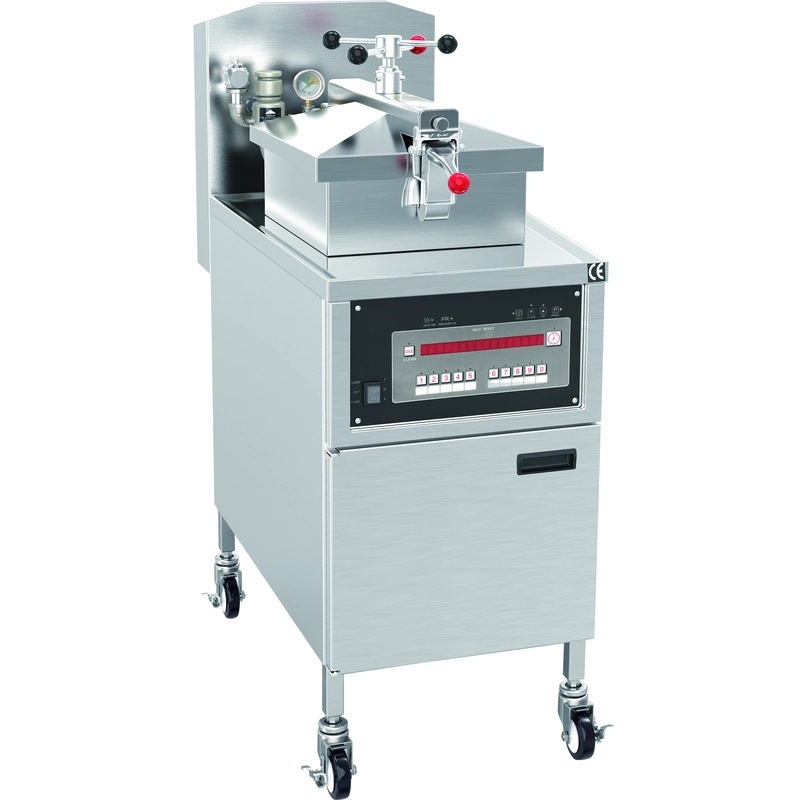
Jinmaide’s commercial fryer product range includes open fryers, pressure fryers, lift configurations, and related equipment. Buyers should distinguish open frying from pressure frying at the start of the project. The gas-powered lift product discussed here is presented as an open fryer; it should not be treated as a pressure fryer for chicken simply because both appear in the same commercial category.
Decide Whether Automatic Basket Lifting Solves a Real Problem
Automatic lifting can raise the basket when the timer ends. This can reduce the risk of food remaining submerged because an operator is occupied with another task. It can also support more repeatable work across shifts when cook programs are clearly defined.
The feature does not replace recipe development or staff procedures. The buyer should confirm basket travel, maximum loaded basket condition, program control, manual override, behavior after a power interruption, cleaning access around the lifting mechanism, and the checks required before each shift. If several products use different cook profiles, ask how menus are created, protected, recalled, and changed.
For a low-volume site with one experienced operator, automatic lifting may offer limited value relative to footprint or maintenance priorities. For a chain kitchen with frequent staff changes and overlapping tasks, it may have greater operational benefit. The correct decision comes from observing the service process, not from ranking features.
Confirm the Exact Model and Published Boundaries
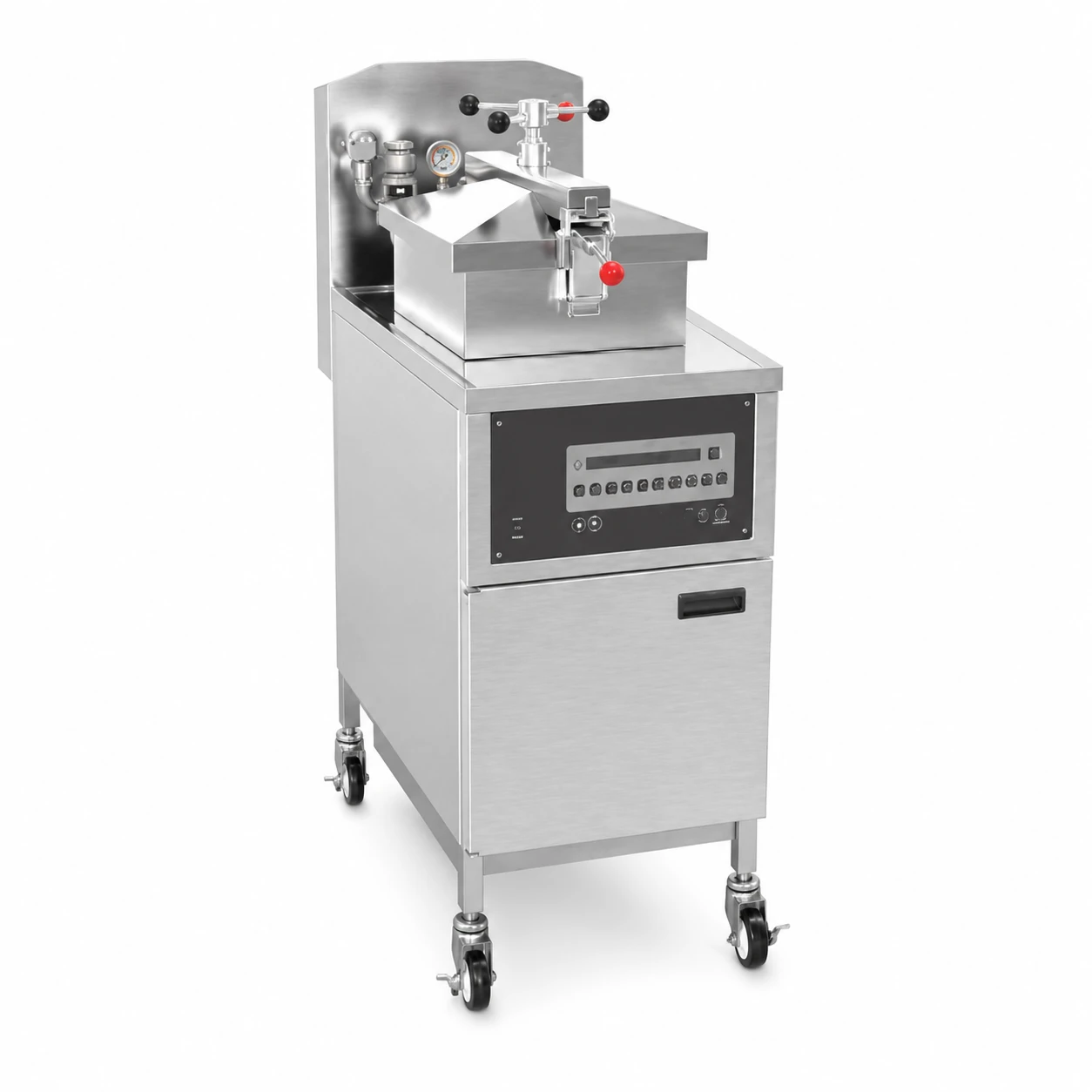
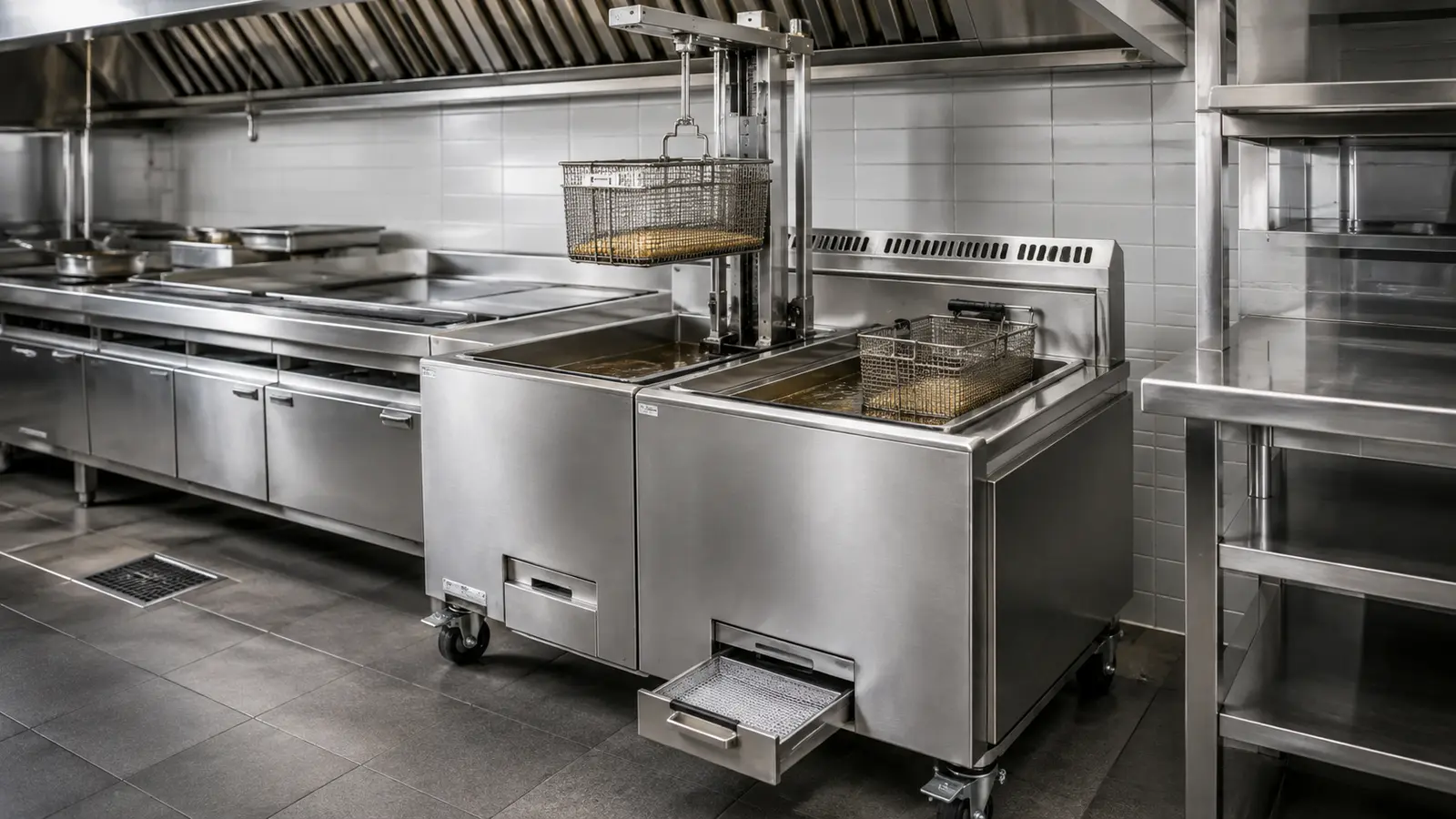
The gas-powered lift fryer configurations shown by Jinmaide include single- and dual-tank versions, with and without automatic lifting. The page lists OFG-221, OFG-H221, OFG-222, and OFG-H222 configurations. It also shows LPG or natural gas as energy options, microcomputer temperature control, saved menus, a melting mode, oil filtration, an inclined vat bottom for draining, and a movable oil tank.
The published table identifies 38 L for a single tank and 38 L × 2 for dual tanks, a stated 90°C–190°C temperature range, and a 200 V 50/60 Hz electrical control supply. These values should be treated as model-selection inputs, not copied blindly into a purchase order. The buyer should ask the supplier to confirm the chosen model, tank arrangement, lifting function, electrical requirement, gas version, thermal input, overall dimensions, net weight, included baskets, filtration equipment, connectors, and any differences from the website.
If a project requires a different voltage or control supply, request written engineering confirmation rather than assuming that a plug change is sufficient. Control power, motors, protective devices, and internal wiring may all be affected.
Match the Gas Configuration to the Installation Site
“LPG” or “natural gas” is not a complete installation specification. The supplier needs the gas family, local supply pressure, regulator arrangement, connection standard, and destination requirements. The buyer’s licensed local installer should confirm the final gas train, shutoff arrangement, leak testing, combustion ventilation, and commissioning procedure.
Ask the supplier to return a gas data sheet for the exact model. It should identify the configured fuel, required inlet conditions, rated input, connection point, and any site components excluded from supply. If conversion between gases is permitted, request the approved conversion procedure and parts scope; do not assume field conversion is always allowed.
Commercial cooking ventilation and fire-protection requirements depend on the equipment and local authority. NFPA 96, for example, addresses ventilation control and fire protection for commercial cooking operations in jurisdictions that use it. A buyer should not apply one country’s rule universally. Instead, provide the final kitchen layout to the local designer or authority and return confirmed hood, clearance, suppression, and interlock requirements to the supplier.
Review Oil Management as Part of Daily Capacity
Oil filtering, draining, refilling, and cleaning consume working time. A fryer that cooks quickly can still slow the kitchen if filtration is awkward or if the drain route conflicts with the room layout. Review where the movable oil tank travels, whether it clears nearby equipment, how hot oil is contained, how filter components are accessed, and where waste oil is transferred.
The inclined vat bottom and built-in filtration described on the product page should be checked in a representative cleaning procedure. Ask for the sequence, warm-up or melting process, filter consumables, removable parts, cleaning tools, and operator protection required by the manufacturer. The buyer should also state whether the kitchen handles multiple oils or allergen-sensitive menu items, because this may influence tank separation and cleaning controls.
Efficiency should be evaluated with evidence, not slogans. Recognized fryer programs distinguish cooking energy efficiency from idle energy rate, showing why a high thermal input alone does not establish operating cost. If energy performance is a purchasing criterion, ask for the test method, operating conditions, model identity, and complete report. Do not infer certification from an unverified efficiency claim.
Freeze Installation and Service Access
Create a scaled cookline drawing that shows the fryer, hood, fire-protection system, gas and electrical connections, drain and filtration movement, adjacent equipment, walls, aisles, and operator position. Confirm overall machine dimensions, caster and brake arrangement, service panels, control-panel access, basket-lift clearance, and the path used to deliver the equipment.
Movable casters help cleaning and service only when hoses, cables, connectors, and hood coverage are designed for the movement. Ask which connections are flexible, how movement is limited, and what must be isolated before the unit is pulled out. The final arrangement should be approved by qualified local trades.
For spare parts, request an exploded list or part-number method for filters, seals, baskets, controls, sensors, ignition-related parts, lift components, and high-wear items applicable to the chosen model. Clarify which items are included with the machine and which are optional. This is more useful than requesting a generic “spare parts package.”
Use an Application-Based Acceptance Plan
Acceptance should confirm both equipment functions and the intended food process. Before shipment, the buyer can ask for model and nameplate review, visual inspection, tank and basket confirmation, control and timer checks, lifting movement, temperature observations, filtration and drain checks, caster and brake checks, accessory count, and packing records.
At site commissioning, qualified installers should verify gas and electrical connections, ventilation and fire-protection interfaces, leaks, ignition, controls, temperature behavior, lift operation, and safe shutdown according to the applicable local requirements and manufacturer instructions. A food trial should then use the buyer’s agreed product, load, starting condition, temperature, cook time, and acceptance result.
Record what the supplier is responsible for before shipment and what the buyer or local contractor completes on site. This boundary avoids treating factory functional checks as proof of an installed kitchen system.
What Should the Inquiry Include?
Send the menu, portion and batch data, peak service profile, preferred single or dual tank, automatic-lift requirement, LPG or natural-gas details, inlet pressure information, electrical control supply, room and hood drawing, filtration routine, installation clearances, destination requirements, order quantity, requested documents, spare-parts needs, and acceptance plan. Buyers can submit these details through Jinmaide’s commercial fryer configuration inquiry form. Ask the supplier to return the recommended model, marked technical sheet, gas and electrical schedule, included accessories, installation exclusions, available evidence, and quotation scope.
Conclusion
The best deep fryer for commercial use is not defined by a single tank size or feature list. A suitable gas-powered lift fryer matches the menu, peak workflow, tank separation, operator routine, gas supply, oil-management process, cookline layout, and local installation rules. When these inputs are frozen before quotation, buyers can compare configurations on production fit and evidence instead of choosing from incomplete model descriptions.