BLOG
What Should Buyers Ask a Commercial Bakery Oven Manufacturer Before an RFQ?
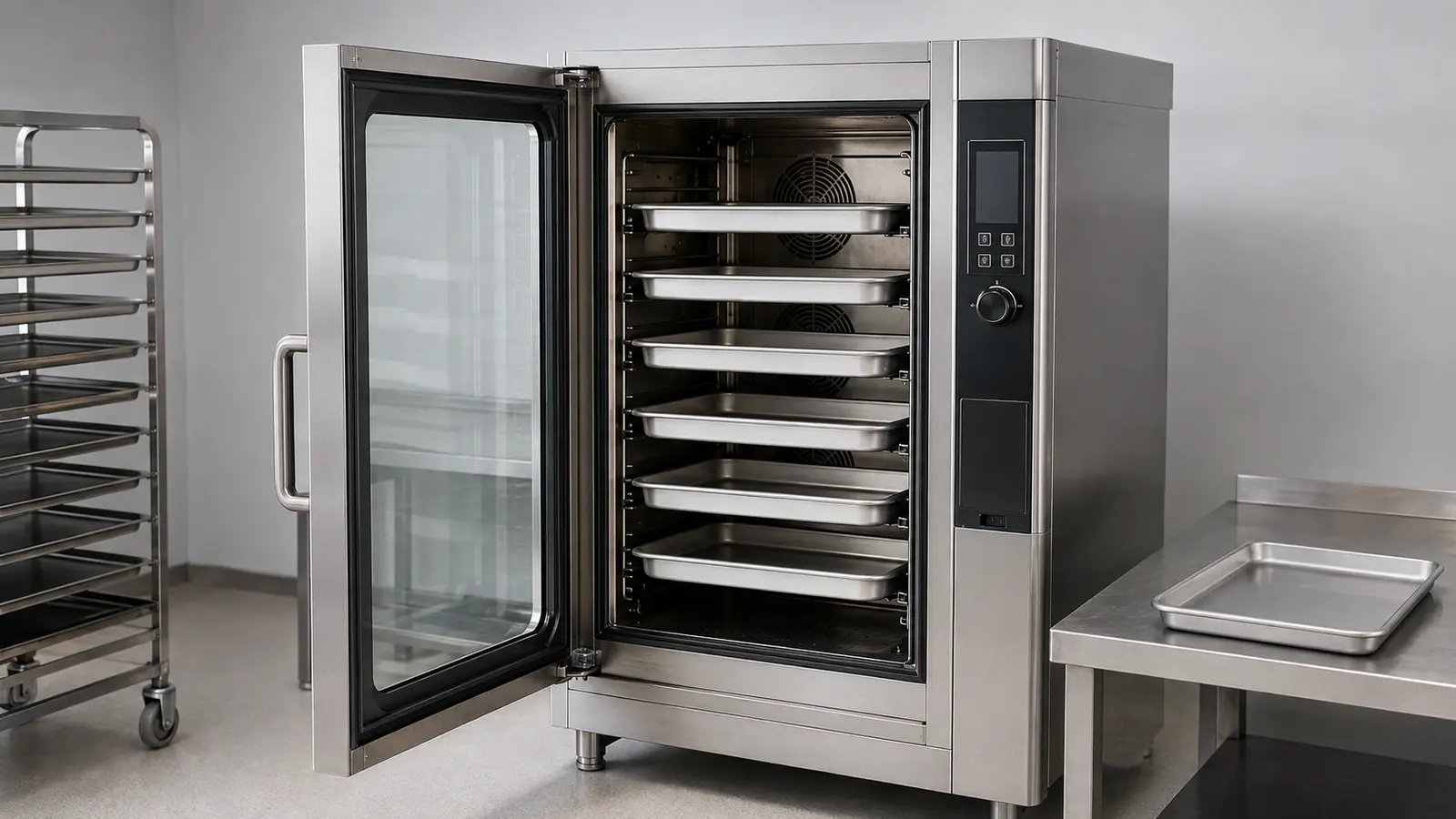
Before sending an RFQ, buyers should ask a commercial bakery oven manufacturer to confirm product scope, suitable oven type, tray format, batch target, power and utility requirements, installation conditions, available test evidence, spare parts, documentation, packaging, and quotation exclusions. A supplier should answer against a defined application rather than a generic request for “a bakery oven.” Some searches use the phrase “bakery ovens manufacturer producer,” but the practical buying question is whether the supplier can match one documented production requirement and return evidence that makes the offer reviewable.
This supplier-qualification step is different from selecting oven capacity. Capacity planning asks how much product the bakery must make. Supplier qualification asks whether a candidate can translate that requirement into the right configuration, disclose boundaries, and support approval before shipment. The questions below help a distributor, bakery project team, hotel kitchen, or food production buyer prepare a comparable RFQ.
1. Does the Supplier’s Product Scope Match the Baking Process?
Start by describing the products to be baked, not by requesting the highest-capacity or most feature-rich model. Bread, pastry, cake, cookies, pizza, and prepared foods can require different combinations of heat transfer, airflow, humidity, deck behavior, loading method, and operator control. A supplier that offers several oven families should explain why one route fits the process and where it does not.
Buyers can first review Jinmaide’s commercial baking oven range, which includes hot-air circulation ovens, deck ovens, rotary formats, proofing equipment, and related bakery systems. The category view is useful for orientation, but it is not a finished specification. The RFQ should identify the food, unit weight, loading pattern, target appearance, batch size, operating hours, and expected changeover frequency.
Ask the supplier to return a proposed oven type and a short application explanation. If a model is recommended, the response should state which project inputs drove the choice. This makes it easier to distinguish a technically reasoned proposal from a quotation based only on a familiar tray count.
2. Which Production Inputs Were Used for Model Selection?
A tray count by itself does not establish hourly output. The real result depends on tray dimensions, usable loading area, pieces per tray, product mass, baking temperature, heat-up behavior, cycle time, loading and unloading time, and recovery between batches. Product mix also matters: an oven that handles one bread program may not produce the same output when the buyer changes to dense pastry or frequent small batches.
Request a calculation basis with the quotation. It can be simple, but it should show:
- food product and representative recipe or process range;
- pieces or kilograms loaded per tray;
- number and dimensions of trays used in the calculation;
- estimated bake and handling time per cycle;
- expected batches per operating hour; and
- conditions that could reduce the estimate.
This is not a promise of identical production in every bakery. It is a transparent basis for comparison and sample testing. If two suppliers use different assumptions, the buyer can normalize them before comparing price.
3. Are Electrical, Steam, Exhaust, and Space Requirements Complete?
Utility confirmation should happen before the purchase order. Ask for rated voltage, phase, frequency, connected power, cable and protection recommendations, steam or water requirements where applicable, drainage needs, exhaust provisions, and allowable installation clearances. The buyer should provide the destination electrical supply and site restrictions rather than asking the supplier to infer them from the country name.
Commercial oven safety requirements differ by oven type and destination. For example, electrically operated forced-convection ovens and other commercial baking appliances can fall under different equipment standards. The RFQ should therefore name the intended market and required conformity route. The supplier should list the documents available for the exact quoted model; a catalog statement about another product should not be accepted as model-specific evidence.
Space drawings should include door swing, tray access, service access, ventilation space, connection points, and the route used to bring the machine into the building. A unit may fit the final kitchen position but still be impossible to move through a doorway or turn in a corridor.
4. Can the Supplier Return a Model-Specific Specification?
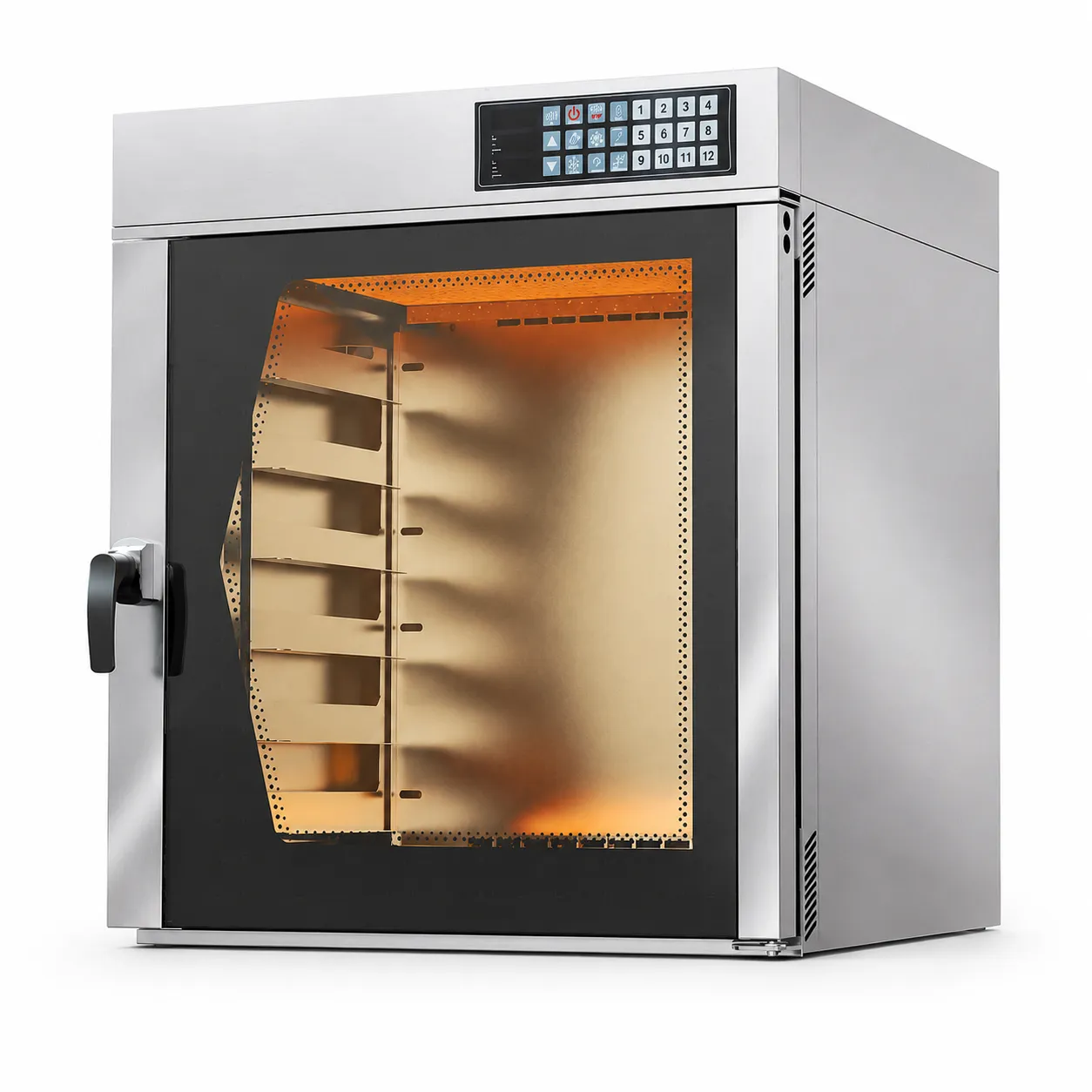
A useful product page provides a starting point for technical clarification. Jinmaide’s six-tray hot air circulation electric oven, for example, lists six trays, a 40 × 58 × 1.5 cm tray format, 380 V three-phase supply, 11 kW rated power, and a stated temperature range from room temperature to 300°C. It also describes a microcomputer panel with menu memory, two fan speeds, steam humidification, automatic exhaust, and a door switch that stops the circulating fan.
Those details should still be confirmed against the selected model and order revision. The same page lists two configurations with different overall dimensions and net weights. The RFQ response should clearly identify the model code, included accessories, tray supply, stand or base arrangement, control version, and any differences from the published page.
Ask for a marked specification sheet rather than a collection of screenshots. Every value should relate to one model code. If the buyer requests a change, the supplier should return a revised sheet showing what changed and whether the modification affects price, utilities, testing, or delivery scope.
5. What Evidence Will Be Available Before Shipment?
“Quality checked” is too broad for an RFQ. Buyers should define the evidence they need and ask what the supplier can actually provide. Depending on the project, useful evidence may include incoming-component records, assembly inspection, electrical checks, temperature observations, timer and control verification, fan and door-switch checks, steam-function checks, photographs, packing records, and a final nameplate review.
If third-party test reports are required, confirm the exact model coverage, standard edition, laboratory identity, report number, and whether the requested configuration is within the tested scope. ISO/IEC 17025 is a reference for competent testing and calibration laboratories, but laboratory competence does not automatically make an unrelated report applicable to the buyer’s model.
The buyer should send an acceptance sheet with measurable items and pass criteria. The supplier should return the proposed test method, instruments, sampling basis, and report format. This prevents both parties from discovering after production that they expected different proof.
6. Which Commercial Boundaries Must Be Written Into the Quote?
A quotation should separate the base machine from options and project services. Ask whether the price includes trays, racks, stand, steam components, connectors, cables, plugs, spare parts, manuals, export packing, documentation, testing, and commissioning support. Also confirm the quoted quantity, destination basis, validity period, payment terms, sampling arrangement, and the event that starts the production schedule.
Packaging should be treated as a technical deliverable. Request packed dimensions, gross and net weight, handling points, protection for glass and control panels, moisture protection where required, and pallet or crate assumptions. If the machine will be transferred between warehouses or installed through a restricted route, give the supplier those conditions before the packing plan is frozen.
Warranty, spare parts, and technical support should be written as specific boundaries rather than promotional claims. Ask which parts are recommended for the first operating period, how part numbers will be identified, what diagnostic information the supplier needs, and which support channels are available. Do not assume that a general “after-sales service” statement covers travel, labor, freight, or local installation.
7. How Will Configuration Changes Be Controlled?
Bakery projects often change after the first quotation. A buyer may revise the tray format, add steam, change the control panel, request another voltage, alter the stand, or update the room layout. Each change can affect connected load, dimensions, accessories, test scope, packing, and price. Ask the supplier to use a revision number on the specification, drawing, quotation, and approval record so every department works from the same configuration.
The supplier should return a change summary that identifies the old requirement, new requirement, technical effect, commercial effect, and evidence that must be repeated. The buyer should avoid approving isolated messages or unmarked images when a formal drawing has already been issued. The purchase order should reference the final approved revision, and the nameplate, manuals, packing list, and pre-shipment record should use the same model identity.
Change control is also useful when a distributor plans repeat orders. If a component becomes unavailable, the proposed replacement should be reviewed for function, interface, documentation, and service parts before it enters production. A familiar model name alone does not prove that two production batches have the same controlled configuration.
8. Use a Supplier Return Matrix
The following matrix keeps the RFQ short while making omissions visible.
| Buyer provides | Supplier returns | Review evidence |
| Menu, product sizes, and batch target | Recommended oven type and model | Selection basis and capacity assumptions |
| Destination utilities and room drawing | Connection schedule and installation envelope | Dimensioned technical drawing |
| Target market and conformity requirements | Available model-specific documents | Report and certificate scope review |
| Requested functions and accessories | Included, optional, and excluded items | Marked quotation and bill of supply |
| Acceptance and packaging needs | Inspection plan and packing proposal | Approved sample or pre-shipment record |
Frequently Asked Questions
Is a product catalog enough to qualify a bakery oven supplier?
No. A catalog shows product scope, but qualification also requires a model-specific specification, application assumptions, utility schedule, evidence plan, quotation boundary, and a clear process for revisions.
Should buyers ask for the lowest oven price first?
Price is meaningful only after scope is aligned. A lower offer may exclude trays, steam components, packing, documents, spare parts, or testing that another supplier included.
Can one test report cover every oven in a supplier’s range?
Not automatically. Buyers should check the model identification, construction, standard edition, laboratory, and stated scope before accepting a report as evidence for the quoted oven.
What should be frozen before placing the order?
Freeze the model code, technical specification, utilities, installation drawing, included accessories, acceptance plan, packing method, commercial terms, and revision number referenced by the purchase order.
Send a Complete RFQ Package
A complete inquiry should include the products to be baked, tray format, batch and hourly target, operating schedule, power supply, water or steam needs, exhaust conditions, installation space, destination market, required documents, preferred options, order quantity, packing route, and acceptance expectations. Jinmaide invites buyers to share product, target output, and installation conditions through its commercial bakery equipment inquiry form. Ask for a returned model recommendation, marked specification, utility schedule, bill of supply, evidence list, and quotation exclusions.
Conclusion
A credible commercial bakery oven RFQ is built around a defined baking process and a model-specific evidence path. Buyers should qualify how the supplier selects equipment, confirms utilities, controls revisions, documents testing, and states commercial boundaries. When every candidate answers the same inputs, the final comparison reflects real scope instead of product-page impressions or an incomplete unit price.