BLOG
How Much Oil Does a Commercial Deep Fryer Use? Capacity vs. Daily Consumption
How much oil does a commercial deep fryer use? There is no single daily figure. A fryer’s listed oil capacity describes its vat configuration; the amount of fresh oil a kitchen actually adds depends on the model’s specified fill level, the vats being operated, food carried out of the oil, top-ups, filtering and full or partial oil changes. A 25 L-capacity fryer should not be described as using 25 L of new oil every day. Jinmaid publishes commercial pressure and open fryers with different nominal oil capacities, from smaller tabletop units to larger single-vat and multi-vat machines. Those figures can guide equipment selection, but they are not measurements of daily consumption. Buyers need to separate equipment capacity from oil purchasing and replacement records before estimating operating costs.
What Does “Oil Use” Mean in a Commercial Deep Fryer?
The phrase can refer to at least four different quantities. Confusing them leads to inaccurate purchasing estimates, especially when one comparison includes a newly filled fryer and another includes a machine that is already in service.
Rated Oil Capacity vs. Initial Oil Fill
Rated oil capacity is a product specification for a particular vat or fryer configuration. Initial oil fill is the volume the operator adds to reach the approved operating level under the model’s instructions. The numbers should not be assumed equal without documentation. Some specifications refer to a nominal vessel capacity; safe levels depend on the marked fill range and the manufacturer’s procedure. Treat a website capacity number as a model-selection figure, not permission to fill the pot to the rim.
Daily Oil Top-Ups vs. Complete Oil Replacement
Top-up oil is fresh oil added to replace oil that has left the system or to restore an approved operating level. Complete replacement involves removing the used oil and introducing a new charge under the equipment’s authorized procedure. On a day with no full replacement, fresh oil added might be only the top-up amount. On an oil-change day, the amount of new oil introduced can be much greater, even if food output is unchanged.
Why These Numbers Should Not Be Used Interchangeably
Oil bought from a wholesaler, oil poured into the fryer, oil carried away with food and oil discarded as waste are different accounting quantities. A restaurant may have oil in unopened stock, oil in active vats and recovered used oil awaiting disposal. They belong in separate records if the objective is to calculate oil cost per operating day or per kilogram of finished food.
How Much Oil Do Different Commercial Fryer Sizes Hold?
Small Countertop Pressure Fryers
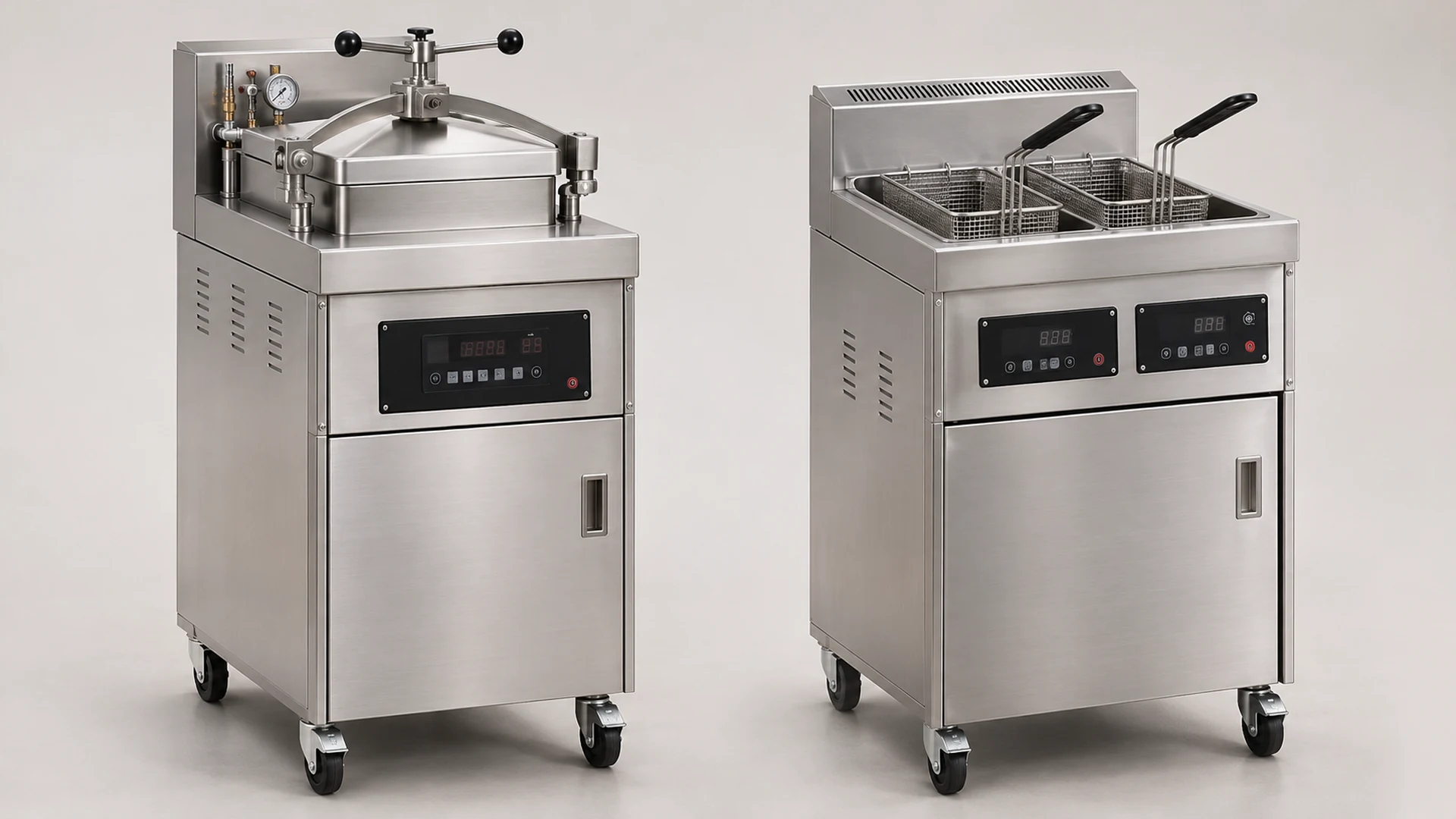
Jinmaid’s tabletop electric pressure fryer product page lists a 10 L oil capacity for model PFE-16 and 12.5 L for model PFE-22. Both are electric pressure-frying configurations rather than general-purpose open fryers. Their size can be relevant to a smaller production task, but a buyer still has to verify the permitted batch load, oil-level markings and operating procedure before treating either as suitable for a specific kitchen.
Floor-Standing Commercial Fryers
For a larger gas pressure-frying format, Jinmaid publishes 25 L for the PFG-800 gas pressure fryer. Its OFG-221 gas open fryer lists 38 L for a single vat. These capacities belong to different equipment and cooking methods. The 38 L label does not tell a reader how many kilograms of food the machine can produce each hour, nor does it predict its daily fresh-oil requirement.
Single-Vat, Dual-Vat and Multi-Vat Fryers
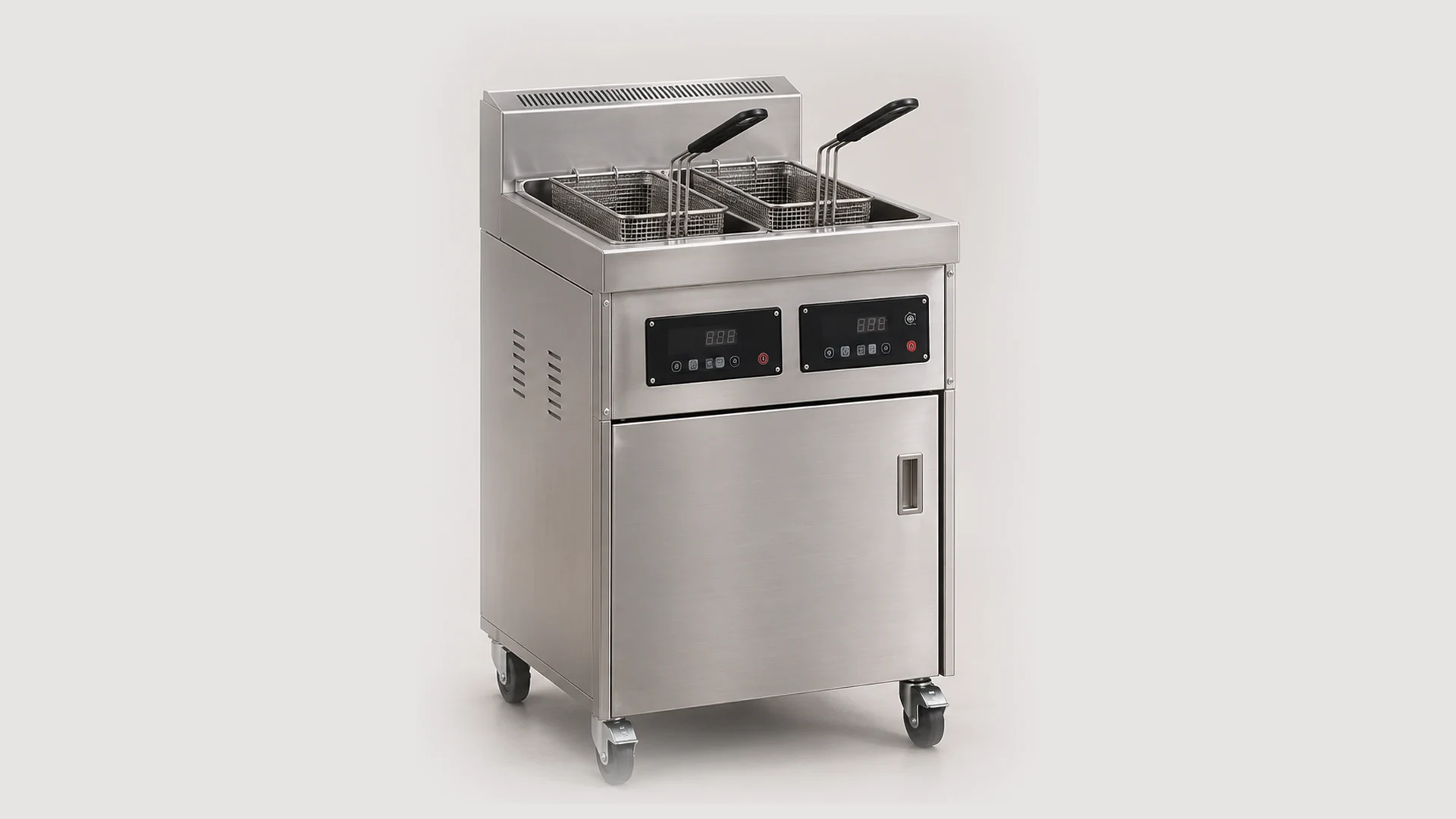
Multi-vat specifications often use a multiplication sign to state capacity per vat. Jinmaid lists 38 L × 2 for its OFG-222 dual-tank gas fryer, 11.5 L × 2 for the OFE-122 electric open fryer and 11.5 L × 4 for the OFE-124 electric open fryer. That means 76 L, 23 L and 46 L respectively as combined nominal capacity if all listed vats are counted; it is not a single shared tank or proof that all vats need to operate simultaneously.
| Jinmaid model | Published vat arrangement | Combined nominal capacity | What the figure does not show |
|---|---|---|---|
| PFE-16, electric pressure | 10 L × 1 | 10 L | Actual fill line or daily consumption |
| PFE-22, electric pressure | 12.5 L × 1 | 12.5 L | Actual fill line or daily consumption |
| PFG-800, gas pressure | 25 L × 1 | 25 L | Food output per hour |
| OFG-221, gas open | 38 L × 1 | 38 L | Food output per hour |
| OFG-222, gas open | 38 L × 2 | 76 L | Whether both vats are used every shift |
| OFE-122, electric open | 11.5 L × 2 | 23 L | Operating fill for each vat |
| OFE-124, electric open | 11.5 L × 4 | 46 L | Actual number of operating vats |
The model values above are taken from Jinmaid’s published product specifications, not from measured filling or restaurant-consumption trials. Confirm the applicable manual and supplied model before placing an oil order.
How Much Oil Should Be Added Before the First Frying Cycle?
Checking the Manufacturer’s Fill-Level Instructions
Use the instructions for the exact fryer and vat, including the approved cold-oil or solid-shortening procedure, the minimum/maximum oil marks and any temperature-dependent instructions. For pressure fryers, follow the model-specific loading, lid and pressure operating procedure as well. The nominal capacity number should never be substituted for these instructions. Where a product page does not publish the required fill quantity, request the operating manual rather than guessing.
Why Oil Temperature and Expansion Matter
Frying oil changes volume as its temperature changes. The manufacturer may specify different checks or markings for cold and operating conditions. Loading food also displaces oil, while moisture release can cause vigorous bubbling. Proper oil level therefore depends on both the fryer geometry and how the machine is used—not on the assumption that more oil is always better.
Avoiding Underfilling and Overfilling
Operating below the required level can expose heating surfaces or disrupt the temperature-control conditions for which the fryer was designed. Excess oil reduces room for food displacement and bubbling, increasing overflow risk. Never use an estimated percentage of the published capacity as a replacement for the manufacturer’s fill marks. Staff should follow equipment-specific training and approved hot-oil handling practices; changes to fill levels are not a way to increase the rated food capacity.
What Determines Daily Oil Consumption in a Commercial Kitchen?
Food Type, Breading and Oil Carried Out With Food
Some oil leaves the vat attached to or absorbed by fried food. The amount can vary with product surface area, moisture, breading or batter, food temperature, draining practice and cooking conditions. A heavily breaded chicken operation will not necessarily have the same oil loss per kilogram of finished food as a different menu. Avoid converting generic oil-uptake percentages into a guaranteed result for a particular Jinmaid model or recipe.
Daily Frying Volume and Peak Service Demand
Daily throughput matters because more food passes through the oil, but the relationship is not simply one litre per fixed number of portions. The menu mix and each batch’s oil carry-out matter as well. Compare operations over a defined time period and record both the kilograms of food cooked and the quantity of fresh oil introduced. Separate a quiet day with long idle periods from a busy production day rather than averaging them without context.
Oil Loss During Draining, Handling and Cleaning
Oil may be lost when a vat is emptied, residue is removed, equipment is cleaned or an oil-transfer process is performed. The amount depends on the equipment design and the approved workflow. If a fryer has a filtration feature, some oil may remain in piping, a filter assembly or residue, but there is no basis for assigning a fixed loss per cycle without model-specific measurement. Record such losses separately where practicable.
Oil Quality and Replacement Frequency
Oil can deteriorate during heating and contact with air, water and food residues. Replenishing a vat does not reverse the condition of the oil already present. Replacement decisions must reflect the oil supplier’s instructions, the fryer manufacturer’s procedure, applicable food-safety requirements and any quality monitoring specified by the operation. One kitchen may need a different replacement schedule from another even when both machines have the same nominal oil capacity.
How Can Operators Estimate Daily Frying Oil Use?
Record the Initial Fill and Daily Top-Up Volume
Begin with a record for each vat, not just the fryer as a whole. Record the model, date, whether the vat was empty at the start, the fresh-oil volume introduced, and subsequent top-ups. Also record the day’s operating hours and the approximate mass of food produced. Consistent units are essential: litres of liquid oil should not be mixed directly with kilograms of shortening without an appropriate conversion.
Track Oil Replacement Separately
On an oil-change day, record the used-oil volume removed and the fresh-oil volume added as two separate entries. Do not classify all replacement oil as oil absorbed by food. Likewise, if a vat remains full at closing time, its contents have not vanished merely because a fresh charge was added earlier in the reporting period. For multiple vats, add each vat’s fresh-oil entries only after checking that the same transfer was not counted twice.
Calculate Fresh Oil Used Over a Defined Period
For purchasing and cost accounting, a practical starting metric is:
Fresh oil introduced during the period = fresh fills after emptying + routine top-ups + other measured fresh additions.
This tells you how much new oil was put into the fryers during that period. It is not automatically the same as oil chemically degraded, oil absorbed by food, oil discarded or oil purchased. For a simple daily comparison, divide fresh oil introduced by the number of operating days; for menu-adjusted benchmarking, divide by kilograms of finished fried food and retain the menu and operating context.
Illustrative example, not a Jinmaid test: Assume an unrelated fryer has a manufacturer-approved operating fill of 18 L. During a seven-day reporting period, it is filled once from empty with 18 L and receives five separate 1 L top-ups. Its fresh-oil additions total 23 L for the period. This figure does not prove that 23 L was absorbed by food or disposed of: some oil may remain in the vat at the end of the week. If the reporting period began with a filled vat, the initial 18 L would not be counted again.
| Daily log field | Unit | Why it is recorded |
|---|---|---|
| Fryer model / vat ID | Identifier | Avoids combining unrelated configurations |
| Published nominal oil capacity | L per vat | Identifies equipment size, not consumption |
| Fresh oil added after emptying | L | Captures complete or partial refill events |
| Routine top-up oil | L | Captures additions during normal service |
| Used oil discarded | L | Tracks waste separately from fresh input |
| Finished food output | kg/day | Provides context for comparing periods |
| Operating hours | h/day | Separates heavy production from long idle time |
Does a Larger Fryer Always Consume More Oil?
Frypot Volume vs. Actual Food Throughput
A larger operating fill can require more oil at startup or when the vat is completely refreshed. It does not prove a higher ongoing oil requirement for a given amount of food. A larger vat that supports efficient batch handling may serve a busy menu differently from a small vat that is continuously overloaded. To compare equipment, keep food type, batch mass, total output and the replacement policy visible alongside capacity.
Why Two Fryers With the Same Oil Capacity May Use Different Amounts
Two nominally 25 L fryers can have different fresh-oil records if one prepares battered foods at high volume while the other handles a lower-load menu, or if they follow different oil-management procedures. Even a perfect capacity match would not control for food carry-out, maintenance losses, filtering or disposal decisions. A sound cost forecast therefore uses operating data from the intended menu rather than capacity alone.
The Effect of Single-Vat and Multi-Vat Operation
A dual-vat fryer provides separate oil compartments; whether both need to run depends on the menu and shift. For example, the OFE-122 is listed as 11.5 L × 2, while the OFE-124 is 11.5 L × 4. Adding the advertised capacities gives 23 L and 46 L, respectively, but operating one vat is not the same as operating all vats. Confirm that the model permits the intended independent-vat operation and follow the approved fill and heating instructions.
Can Filtration Reduce the Need for Fresh Frying Oil?
What Oil Filtration Removes
Filtration can remove crumbs and other suspended particles within the filter system’s designed capability. That can help control the amount of residue left in the hot oil and support a documented maintenance routine. Jinmaid’s electric open-fryer page describes built-in filtration, but the public description does not establish a filter rating or a measured oil-saving percentage. Ask for the actual drain-return sequence, consumables and the approved operating procedure for the quoted model.
Why Filtration Does Not Restore Degraded Oil
Particle filtration does not reverse oxidation, hydrolysis or other chemical changes that have already occurred in frying oil. Cleaner-looking oil is not necessarily oil that remains suitable for use. The correct replacement decision depends on applicable rules, manufacturer recommendations and the kitchen’s chosen quality assessment, rather than a universal number of operating days.
When Oil Quality Should Trigger Replacement
Follow the oil supplier’s quality limits and the fryer manufacturer’s operating guidance. Persistent off-odours, excessive foaming or changes in food results can warrant investigation, but appearance alone should not replace any required oil-quality testing. Record disposal events and fresh refills separately so that a change in replacement frequency is not mistakenly described as a change in food absorption.
How Should Buyers Choose Fryer Oil Capacity Before Ordering?
Match Frypot Capacity to Batch Size and Menu
Start with the foods and typical basket loads, then define peak-period demand and whether separate vats are needed for menu separation. A small countertop pressure fryer, a single large open fryer and a four-vat open fryer solve different service problems. Jinmaid’s commercial fryers range offers several formats, but choosing by nominal litres alone would ignore production method and workflow.
Compare Oil Capacity With Heating and Recovery Requirements
Confirm the installed energy supply and request model-relevant information about preheat, temperature recovery and practical batch size. A greater volume of oil affects the initial amount needed to charge the vat, but it does not establish which fryer will recover faster or cook more food. If operating-cost estimates are important, request measurable cooking and idle conditions for a defined workload, not a savings claim derived from capacity.
Confirm Model-Specific Oil and Utility Specifications
Before ordering, request the exact model and vat layout, stated capacity, approved fill-level instructions, cooking method, power or gas requirements, dimensions, cleaning and filtration procedure, and applicable operation manual. For distributors, specify which variant the information belongs to; a specification from a different Jinmaid model should not be treated as automatically valid for the quoted machine.
Frequently Asked Questions
Is a 25 L Fryer Filled With Exactly 25 Litres of Oil?
Not necessarily. A 25 L listing is the published nominal oil capacity. Use the actual model’s approved fill marks and operating instructions to establish how much oil to add before use.
Does a Dual-Vat Fryer Need Twice as Much Oil?
If both equal-sized vats are prepared for operation, their combined nominal capacity is twice that of one vat. Actual approved fills and whether both vats need to run must still be confirmed from the specific model instructions.
How Much Oil Does a Restaurant Deep Fryer Use Per Day?
There is no fixed answer from equipment size alone. Record daily fresh fills and top-ups, distinguish complete changes, and compare the result with food output, menu mix and operating hours.
Does Filtering Oil Eliminate the Need for Replacement?
No. Filtration can remove some food particles, but it does not restore chemically degraded oil. Replacement remains subject to oil-quality criteria, applicable rules and the manufacturer’s procedure.
Bottom line: Use nominal oil capacity to shortlist equipment; use approved fill instructions to charge the vat; and use actual fresh-oil records to understand operating consumption. Jinmaid publishes capacities for several pressure and open-fryer configurations, but no website capacity value should be turned into a daily oil-consumption guarantee. Buyers can share their menu, estimated food output, number of required vats, available utilities and target market through Jinmaid’s contact page to request model-specific specifications and the information needed for an oil-use estimate.