BLOG
Gas vs. Electric Commercial Fryers: What Should Buyers Compare Before Ordering?
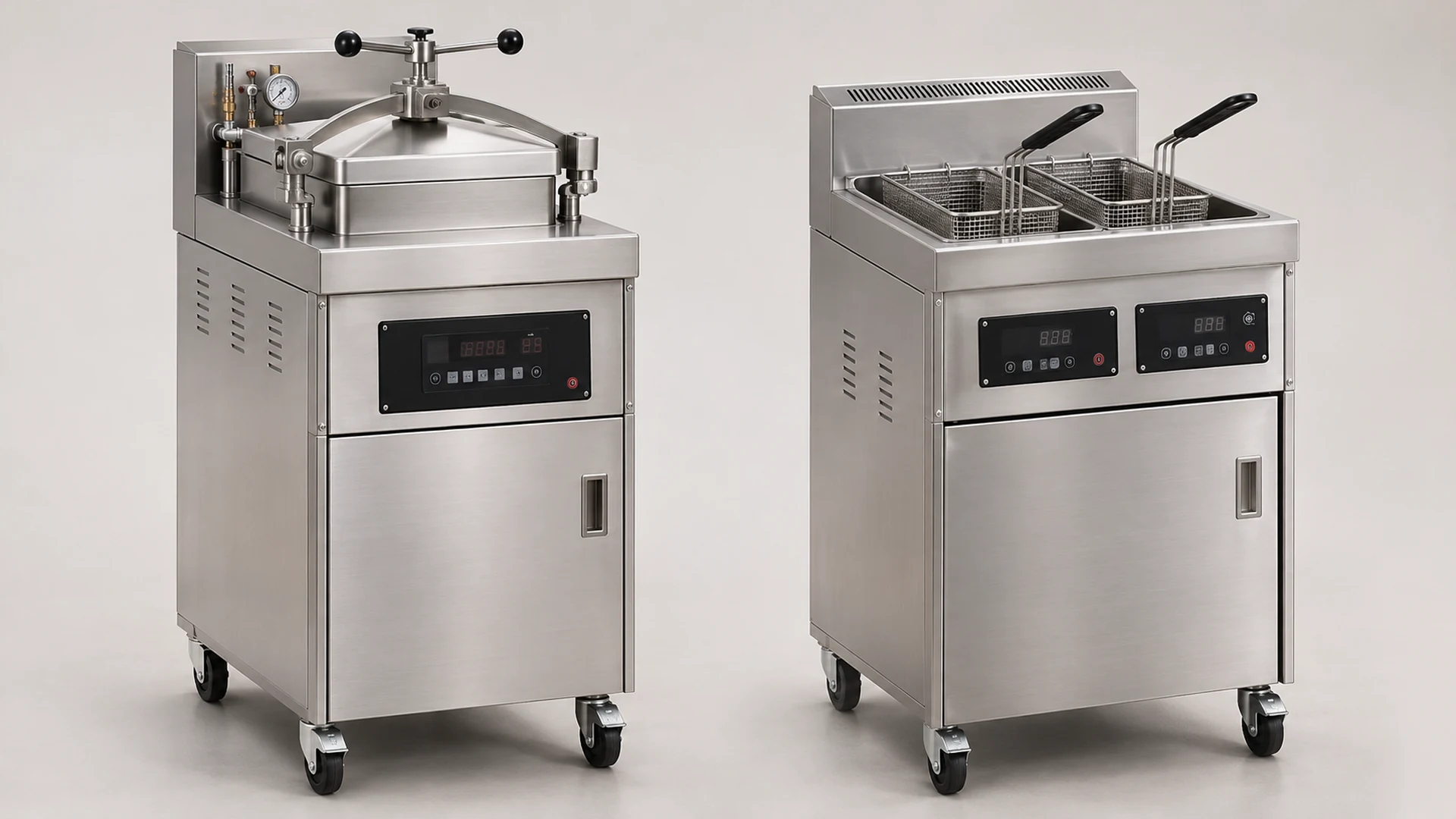
Neither gas nor electric is automatically the better choice for a commercial deep fryer. The right heating source depends on the cooking method, available utilities, peak-hour food demand, measured heating performance and local operating costs. Start by deciding whether your menu needs an open fryer or a pressure fryer: that distinction changes the cooking process, and it is separate from the gas-versus-electric decision. Then compare suitably configured machines using the same food load, oil operating conditions and production target. Jinmaid lists gas pressure fryers, gas open fryers, electric open fryers and tabletop electric pressure fryers. Those product families provide useful specification examples, but their published vat sizes and cooking methods differ, so a model-to-model comparison must state those limits.
Gas vs. Electric Commercial Fryers: What Is the Main Difference?
A commercial gas fryer obtains its primary heat from fuel combustion, while an electric fryer converts electrical energy into heat through electric elements. Both ultimately need to transfer heat into frying oil and maintain the required cooking temperature while relatively cool food is added. A heating-source label does not tell you the appliance’s measured cooking efficiency, oil recovery time or portions per hour.
How Gas Fryers Generate Heat
A gas burner delivers heat through a heat-exchange surface, such as a tube or the fryer vessel itself, depending on design. Part of the fuel’s energy reaches the oil; another part leaves through exhaust and surrounding losses. Buyers should therefore ask for the rated gas heat input and measured fuel use under a defined workload—not just a claim that gas is powerful. Where a unit supports LPG and natural gas, fuel type, inlet pressure, regulator arrangement and any required conversion hardware must be checked for the exact supplied configuration.
How Electric Fryers Transfer Heat to the Oil
Electric units heat the oil with elements placed in or coupled to the frypot. Their electrical input is normally stated in kilowatts, but the nameplate power is not the same as average energy consumption over a day. Element placement, vat geometry, insulation, controls and the proportion of time spent cooking or idling all matter. An electric fryer may fit a kitchen without a gas connection, provided its electrical distribution system can supply the specified voltage, phase and load.
Compare Open Fryers and Pressure Fryers Before Choosing an Energy Source
Open Fryers for Flexible Fried-Food Menus
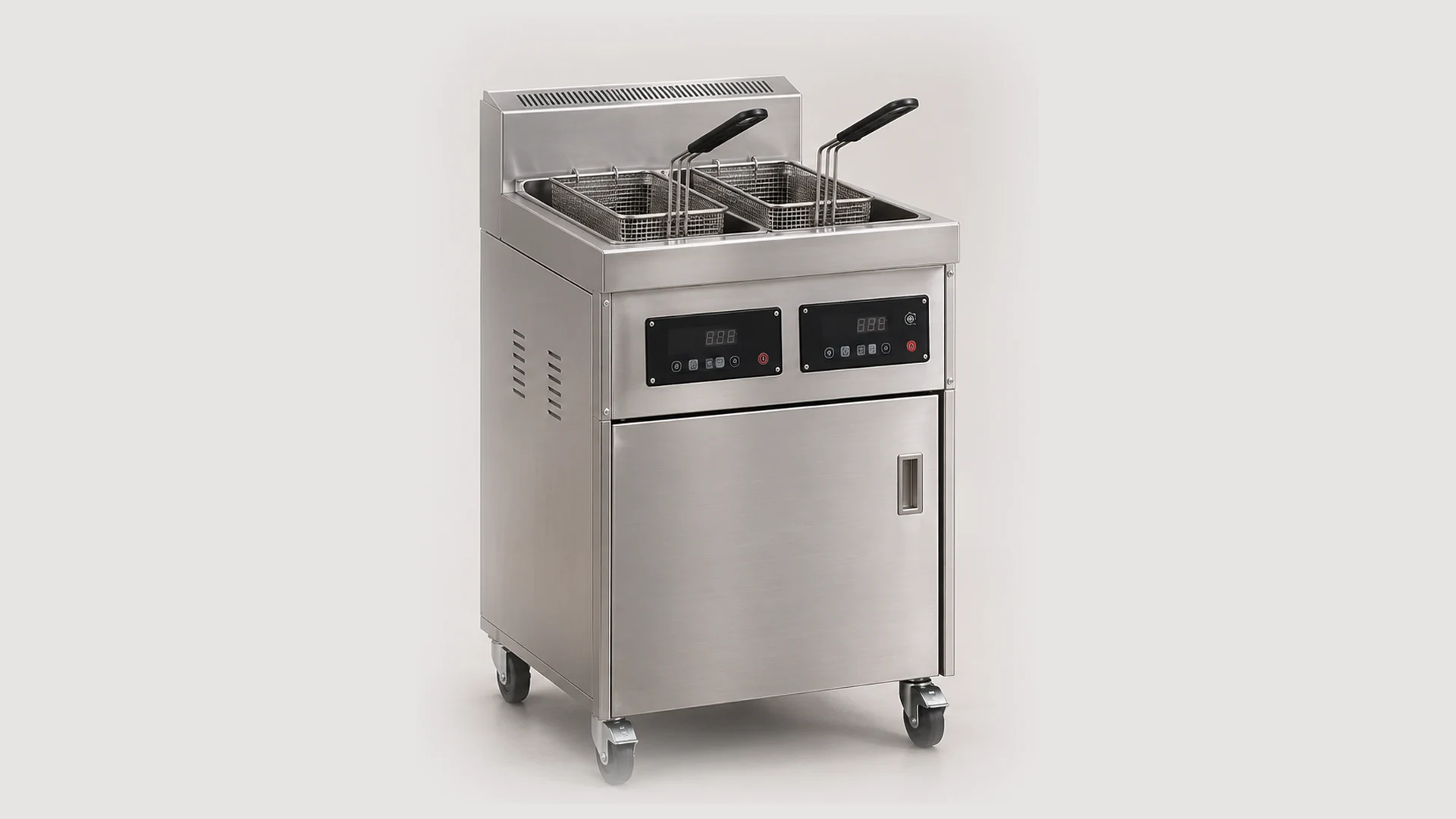
Open fryers cook in a vented oil vat rather than a sealed pressure-cooking vessel. They are used for a range of products, including fries, battered foods and many fried-chicken formats. Basket arrangement and vat separation can be important when the same kitchen prepares different foods. Jinmaid’s OFE electric open-fryer range includes two-vat and four-vat configurations; those configurations should not be mistaken for pressure fryers simply because their controls or lift mechanism are automated.
Pressure Fryers for Specific Chicken-Frying Applications
A pressure fryer is designed to operate with an enclosed vessel and model-specific pressure safeguards. It can be selected for suitable chicken-frying processes where the intended recipe and operating procedures call for pressure cooking. A buyer cannot replace a pressure fryer with an open fryer merely by matching oil capacity and temperature setting. Compare lid and lock arrangements, safety instructions, authorized loading and operating cycles, and staff training requirements as separate purchasing criteria. Jinmaid’s gas pressure fryers and tabletop electric pressure fryers are relevant examples of the pressure-frying category.
Why Automatic Basket Lifting Is a Separate Feature
An automatic lift raises or lowers a basket under the fryer control sequence. It may simplify a repeated handling step, but it does not make an open vat pressure-rated, establish a cooking speed or prove that a model is safer under every operating condition. Treat energy source, cooking method, number of vats and basket automation as four independent specification fields.
Which Utility and Installation Requirements Matter Most?
LPG or Natural Gas Supply Requirements
Before considering a commercial gas fryer, obtain the available fuel, supply pressure, gas-line capacity, connection requirements and locally accepted installation procedure. LPG and natural gas are not interchangeable without the appropriate, approved configuration. Jinmaid lists LPG/natural gas for its OFG-221 gas fryer and PFG-800 gas pressure fryer, but this website listing alone is not confirmation that a particular unit has been configured, tested or approved for a buyer’s local supply. The offered equipment and its documents must match the destination site.
Voltage, Phase and Electrical Load Requirements
Electric fryers can need very different services. Jinmaid publishes 3N–380 V, 50/60 Hz and 14.3 kW for the OFE-122 dual-vat electric open fryer, while the PFE-22 tabletop electric pressure fryer lists 220 V, 50/60 Hz and 3.5 kW. Those are different machines, with different cooking methods and electrical requirements. A facility’s available socket is not sufficient evidence of compatibility: the installer must verify supply voltage, phase, circuit protection, cable sizing and connection method. Gas fryers may also require electricity for controls and associated components; do not mistake an auxiliary power entry for the gas heat input.
Ventilation, Equipment Clearance and Local Installation Approval
Hot-oil cooking has site-level ventilation, fire-protection, service-access and operator-clearance implications, regardless of the heating source. Gas equipment adds combustion and gas-service considerations. Requirements vary by country, jurisdiction, cooking operation and installed appliance. Request the actual dimensions and installation manual, then have the kitchen designer and qualified local installers assess the site; no general product description is a substitute for local approval.
How Do Heating Recovery and Production Demand Affect the Choice?
Preheating Time vs. Temperature Recovery
Preheating measures how long a fryer takes to reach a target oil temperature from a defined starting condition. Recovery concerns what happens after food is loaded: the oil temperature drops, and the heating system must restore it while the cooking process continues. A fryer that preheats quickly is not necessarily the fryer that maintains a consistent result through repeated heavy batches. Ask for the test’s starting oil temperature, food mass, food temperature, target temperature, time between batches and recovery definition before comparing results.
Batch Size and Peak-Hour Frying Output
Peak-hour output depends on food geometry and moisture, basket loading, cooking time, recovery, draining and labor available to handle batches. A buyer serving short lunch peaks should model the busiest 30 to 60 minutes, not divide an optimistic daily food total evenly across the shift. For example, an operation with two distinct menu lines may gain more workflow flexibility from separate vats than from a single larger vat, even when the total listed oil volume is similar. Check the recipe and oil-management requirements before using this as a selection rule.
Why Rated Power Alone Cannot Prove Faster Cooking
A 14.3 kW electric nameplate value and a 14.1 kW rated gas thermal-load entry describe different energy inputs; neither establishes equivalent useful heat at the food. Published commercial-fryer energy criteria distinguish cooking energy efficiency from idle energy rate for this reason. Ask suppliers to use a repeatable cooking test for the same recipe and comparable machine capacity. Do not interpret an industry efficiency threshold as certification of a Jinmaid model unless model-specific documentation confirms it.
How Should Buyers Compare Gas and Electric Fryer Operating Costs?
Electricity and Gas Tariffs in the Destination Market
Gas and electricity bills use different units and tariff structures. A useful purchasing comparison calculates the measured kilowatt-hours or fuel energy used for a defined food output and idle period, then applies the buyer’s own utility tariff. Where electricity charges include peak-demand components or gas supply includes fixed fees, those costs may change the result. A statement that gas is always cheaper ignores both local prices and fryer efficiency.
Actual Energy Consumption vs. Rated Input
Rated input describes a design requirement or maximum input condition; it is not a meter reading for an eight-hour service. Record preheat, active frying and idle periods separately where possible. Compare fuel or electrical use per consistent food output, such as per kilogram of the same finished item, while also recording product quality and cycle time. If a supplier cannot provide tested values, treat the operating-cost calculation as an estimate with stated assumptions rather than a proven saving.
Maintenance and Oil Management Costs
Total operating cost also includes cleaning time, oil handling, filter consumables where fitted, component servicing and downtime. A built-in oil filter can affect handling workflow but does not itself prove lower daily oil use. For both gas and electric models, ask how the vat drains, which parts staff may clean, what service access is required and which spare items are relevant to the model. Compare like-for-like maintenance scopes instead of assuming one fuel type automatically needs less attention.
| Cost variable | Comparable information to request | Why it changes the decision |
|---|---|---|
| Energy | Metered fuel/electricity per defined cooking and idle cycle | Separates real use from input rating |
| Site infrastructure | Gas connection or electrical upgrade scope | Can change installed cost before the first batch |
| Productivity | Finished food per hour at specified loading | Shows whether the machine meets the peak |
| Oil and maintenance | Oil handling, cleaning steps, filters and service plan | Affects recurring labor and consumables |
What Should Buyers Check About Oil Capacity and Frypot Layout?
Single-Vat vs. Multi-Vat Configurations
One larger vat can suit an established high-volume product line. Two independently operated vats may help separate foods or run only the capacity needed at a quieter period, provided the controls and operating procedures support that use. Jinmaid lists 38 L for the OFG-221 single-vat gas open fryer and 11.5 L × 2 for the OFE-122 dual-vat electric open fryer. The latter is 23 L of combined nominal vat capacity, not a 23 L single vat. It is also not an equal-capacity comparison with the OFG-221.
Matching Frypot Capacity to the Menu and Service Pattern
Oil capacity should be considered with safe operating oil level, basket loading, food displacement and batch cycle. More oil does not automatically mean more hourly output or lower oil usage per portion. Buyers evaluating how much fresh oil they will need should distinguish the manufacturer’s specified fill level from nominal capacity and account separately for top-ups and replacements.
Compare Actual Gas and Electric Fryer Models
Gas Pressure and Gas Open-Fryer Examples
The Jinmaid PFG-800 gas pressure fryer lists a 25 L oil capacity and LPG/natural gas as its energy source. The OFG-221 gas open fryer lists a 38 L oil capacity and 14.1 kW rated thermal load. The pressure vessel and open-vat design make these different cooking choices even though both use gas.
Electric Pressure and Electric Open-Fryer Examples
Jinmaid’s PFE-22 tabletop electric pressure fryer lists 12.5 L and 3.5 kW at 220 V. Its OFE-122 electric open fryer lists 11.5 L × 2 and 14.3 kW at 3N–380 V. These published specifications are starting points for a shortlist, not measured comparative cooking results.
| Jinmaid model | Cooking method | Energy source | Published oil capacity | What still needs checking |
|---|---|---|---|---|
| PFG-800 | Pressure | LPG / natural gas | 25 L | Gas input, local gas configuration and installation documents |
| OFG-221 | Open | LPG / natural gas | 38 L | Site gas supply, vat workflow and measured performance |
| PFE-22 | Pressure | Electric, 220 V | 12.5 L | Circuit, approved pressure-frying procedure and capacity |
| OFE-122 | Open, two vats | Electric, 3N–380 V | 11.5 L × 2 | Three-phase service, vat layout and basket arrangement |
Comparison limit: These models are not matched-capacity test pairs. Their different vat sizes, cooking methods and installation requirements prevent a defensible ranking of energy efficiency or cooking speed from the published data alone.
What Should Be Included in a Gas vs. Electric Fryer RFQ?
Required Technical Specifications
Make the requested cooking process explicit: open frying or pressure frying; foods and recipe; typical and peak batch weight; desired baskets or independent vats; nominal capacity range; permitted cooking temperature; target production schedule; and whether automatic lifting or filtration is needed. Ask each supplier to state which request items its quoted model actually satisfies. The Jinmaid commercial fryers category is a useful starting point for comparing the available fryer formats.
Utility, Documentation and Delivery Confirmation
State the destination country, available gas type and supply conditions, electrical voltage and phase, dimensions of the proposed installation area, extraction and fire-protection arrangements, and any documents required for local acceptance. Request model-specific installation and operation manuals, a clear list of accessories and exclusions, maintenance requirements, and the offered delivery scope. If two quotes propose different cooking methods, ask for a revised, normalized quote before comparing prices.
Frequently Asked Questions
Is a Gas or Electric Commercial Fryer Cheaper to Operate?
Neither is universally cheaper. The result depends on local tariffs, measured active and idle energy use, workload, any site upgrades and maintenance. Compare the same finished food output under documented conditions.
Do Electric Fryers Recover Heat Faster Than Gas Fryers?
Not as a general rule. Recovery depends on heating design, delivered heat, oil volume, food load and controls. Ask for comparable recovery tests rather than relying on the fuel type alone.
Can an Electric Fryer Replace a Gas Pressure Fryer?
Only if the alternative meets the required cooking method and site conditions. An electric open fryer is not an automatic substitute for a gas pressure fryer. An electric pressure fryer could be evaluated against the pressure-frying requirements if its capacity and approved procedure are suitable.
What Information Should Be Confirmed Before Ordering?
Confirm menu and batch demand, open or pressure cooking, oil-vat layout, target output, gas or electrical supply, ventilation and clearances, model-specific documents, accessories and the quotation scope.
Bottom line: Choose the frying process first, verify the site’s utilities second, and compare gas and electric options using measured performance and full installed cost—not a single power figure. Jinmaid’s published gas and electric fryer models can help define a technical shortlist. To discuss a particular requirement, send your menu, expected peak output, preferred vat arrangement, destination market and available utilities through Jinmaid’s contact page for model and configuration confirmation.