BLOG
What Evidence Should Buyers Verify Before Sourcing Commercial Baking Oven with Steam Manufacturers?
When comparing commercial baking oven with steam manufacturers, buyers should verify the exact oven configuration before comparing quotations. The evidence should show which steaming, baking and combined steam-bake modes are available, how steam is generated, how airflow and programs are controlled, how the chamber is cleaned and drained, what utilities the selected model requires, and which capacity and dimensional data apply to the quoted unit. A supplier should also return model-specific manuals, specifications, accessories, installation requirements and a deviation list. Without that evidence, two offers can carry the same “steam oven” label while covering different operating and delivery scopes.
A Steam-Capable Oven Must Be Defined by Its Operating Modes
The first evidence question is not whether the supplier uses the word “steam.” It is what the oven can actually do during a production cycle. A commercial bakery may need pure steam for one product, dry baking for another, and a controlled combination of heat and steam for a third. Those are different operating requirements, and the RFQ should state which ones matter.
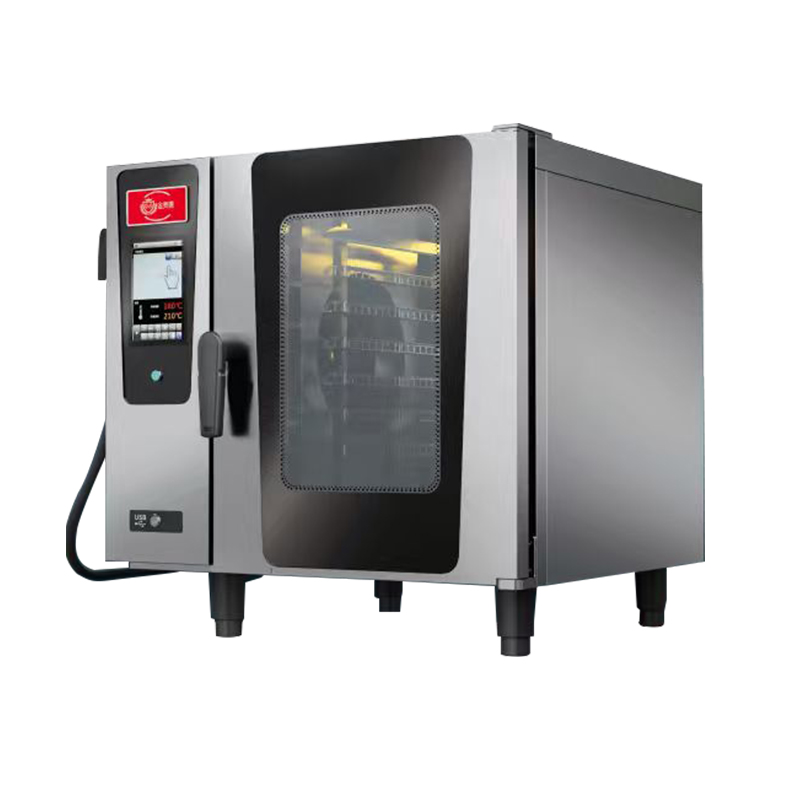
The target Jinmaide product, COMMERCIAL MULTI-PURPOSE STEAM OVEN (TFT HIGH-DEFINITION TOUCH SCREEN), is documented with three operating modes: steaming, baking, and steaming-and-baking. That gives the buyer a verified starting point. It does not, however, define the recipe, humidity level, cycle duration or product result for a particular bakery item. Those settings still belong to product trials and the buyer’s process specification.
This distinction matters because the word “steam oven” is used broadly in commercial equipment. A humidified convection oven, a steam-injection bakery oven and a multi-purpose oven with dedicated steam generation can all appear in the same sourcing search. The supplier’s product page, model sheet and sample test should therefore demonstrate the mode that the buyer intends to use rather than relying on category language.
For buyers evaluating the broader oven family, Jinmaide’s Commercial Baking Ovens category is the appropriate product-discovery route before model-level evidence is reviewed.
Steam Generation Evidence Should Go Beyond “Steam Function Included”
Steam changes both the process and the installation requirement. In bread baking, steam introduced early in the bake can keep the dough surface flexible for longer, supporting oven spring and crust development; once the loaf structure is set, removing excess humidity helps the crust dry and firm. In other products, steam may be used for moisture retention, cooking or regeneration rather than artisan-bread crust formation. A buyer therefore needs to know how the selected oven creates and manages steam, not merely that a steam button exists.
The target product documentation states that the oven is equipped with a dedicated boiler and an automatic humidifier. This is important evidence because it describes an actual steam-generation route. The RFQ should then ask the supplier to confirm the project-side requirements that are not fully defined by the product page:
- required water connection and inlet conditions;
- water-quality requirements or treatment recommendations;
- drain connection and discharge requirements;
- how steam is introduced in each operating mode;
- how the steam system is cleaned or descaled;
- which steam-related components are included in the quoted model;
- what maintenance tasks belong to the operator or service team.
These questions connect the feature to the plant. If the buyer confirms only the steam function but not water and drainage, the equipment may arrive before the site is ready. If the buyer does not define the required steam workflow, the supplier may quote an oven that technically generates steam but does not match the intended bakery process.
Control Functions Should Be Verified Against the Production Method
Controls matter because a commercial oven has to reproduce a production method across shifts, products and operators. The target product page documents a 7-inch TFT touch screen, two wind speeds, storage for 350 programs, and USB image/data management functions. These are useful evidence points, but they have procurement value only when tied to the buyer’s workflow.
A bakery running a narrow product range may need only a few stable programs and clear operator access. A hotel or central kitchen with mixed production may value stored programs because staff can switch between recipes without rebuilding every setting. A distributor may need to know whether program backup or transfer is part of the handover process. In each case, the control feature changes the documentation and acceptance test.
Before approval, ask for a demonstration or sample cycle that proves the required sequence. The buyer can verify whether a program stores the intended mode, temperature, time, fan setting and steam-related steps; whether operators can retrieve and modify the program; and whether USB management is relevant to the project. Do not assume that a high program count automatically improves the bakery. What matters is whether the control structure supports repeatable production and controlled handover.
The two documented wind speeds should be reviewed in the same way. Airflow can influence surface drying, color development and how delicate products react in the chamber. Rather than asking for “strong airflow,” the buyer should define which products will be baked and use product trials to decide which airflow setting is acceptable.
Cleaning, Drainage and Dehumidification Affect Daily Throughput
Commercial kitchens often focus on cooking functions and leave cleaning until after the model has been selected. For steam-capable ovens, that can be a mistake. Moisture, food residue, scale and drainage are part of the operating cycle, so cleaning time and water-management details affect how quickly the oven can return to production.
The target product page documents a fully automatic circulation cleaning system, a double drainage sink arrangement, and automatic dehumidification. The drainage description includes a glass-door sink and a sink outside the cooking chamber connected to the drain pipe. These points give buyers concrete items to inspect during a supplier review.
The practical verification should answer three questions. First, what parts of the cleaning cycle are automatic and what still requires manual access? Second, what chemicals, filters, rinsing steps or maintenance routines are required, if any? Third, how does the drainage arrangement connect to the receiving kitchen?
Dehumidification should also be tied to the recipe. In a steam-bake process, humidity may be valuable early in the cycle but undesirable later when browning and surface drying are required. The buyer should verify how the oven transitions between moist and drier conditions and whether that transition can be built into the selected program. The product page supports the existence of a dehumidification function; the final recipe result should still be proven by a trial with the buyer’s own product.
Door, Lighting and Safety Features Need Model-Level Confirmation
Some evidence is easy to overlook because it does not appear in the headline specification table. The product description lists a three-layer glass door, a two-stage handle, and an internal lighting system using 6000K LED lights. These features influence observation, heat exposure around the door and daily loading practice.
A buyer should not translate these descriptions into a universal safety claim. Instead, inspect the actual sample or current production unit. Confirm the door closes and seals correctly, the handle sequence is clear for staff, the viewing area provides the visibility needed during production, and the lighting remains useful with the tray configuration that will be ordered.
This is also the right point to ask for operating instructions. A product sample proves the physical configuration; the manual should explain safe opening, loading, cleaning and shutdown. If the destination market requires particular equipment documentation or local installation approval, that requirement should be written into the RFQ and verified separately rather than assumed from the product’s general design.
Use the Listed Model Data to Check Site Readiness
The product record provides a specific model entry, so buyers can move from general sourcing language to a site-level check. The listed JMD-DZK6-1/1 specification includes 380V 3N~ power supply, 9.5 kW for baking and 9.5 kW for steaming, an overall dimension of 90 × 85 × 93 cm, a listed capacity of 6-1/1GM, and 7 cm layer spacing.
| Verified Product Field | Published Value | Buyer Verification Before RFQ |
|---|---|---|
| Model | JMD-DZK6-1/1 | Confirm this is the exact model being quoted and that the product sheet, manual and packing list use the same designation. |
| Voltage | 380V 3N~ | Confirm that the destination kitchen has the required electrical service and that the installation team accepts the connection arrangement. |
| Power | Baking 9.5 kW / Steaming 9.5 kW | Use the manufacturer’s electrical information to size the circuit and verify whether any additional connected load applies. |
| Overall dimension | 90 × 85 × 93 cm | Check doorway access, final installation space, service clearance and the surrounding preparation area. |
| Capacity | 6-1/1GM | Confirm the exact pan/container interpretation and included rack configuration with the supplier before using it for throughput planning. |
| Layer spacing | 7 cm | Check that the buyer’s pans, product height and loading pattern fit the spacing used by the supplied rack system. |
The capacity notation deserves particular attention because it should not be interpreted beyond the source data. Instead of assuming a pan standard from the label, the buyer should request a rack drawing or clear tray/pan specification and verify actual usable dimensions. That turns an ambiguous catalog field into evidence that can be accepted at the sample stage.
Capacity Is More Than the Number of Tray Positions
Commercial capacity is a relationship between chamber space, tray format, product height, loading pattern, cycle time and recovery between batches. Two ovens with the same nominal number of positions can deliver different usable output when products require different spacing or when a bakery deliberately leaves positions empty to protect airflow.
For the target steam oven, layer spacing and the buyer’s product height should be reviewed together. A shallow pastry tray and a deep food pan may not use the chamber in the same way. Steam and airflow also need space to move around the load. If the buyer’s throughput calculation assumes every available position can be filled for every product, the final output estimate may be unrealistic.
For RFQ purposes, provide the actual pan or container dimensions, normal loading quantity, largest product height and required batches per hour. Ask the supplier to return the recommended loading arrangement and any operating limitation. If production capacity is critical, use a trial with the buyer’s product rather than relying on a generic catalog output claim.
Supplier Evidence Should Be Organized Before Price Comparison
Once the product requirement is clear, quotations should be normalized around the evidence package. A supplier who quotes only an oven model is not offering the same scope as a supplier who returns the model specification, installation needs, operating manual, cleaning requirements, accessory list and deviation statement.
| Evidence Area | Supplier Should Return | Buyer Should Verify |
|---|---|---|
| Operating modes | Model-specific function sheet or manual | Steaming, baking and combined mode are identified for the exact offered model. |
| Steam system | Boiler/humidifier description and utility requirements | Water, drainage, cleaning and maintenance interfaces are understood. |
| Controls | Touch-screen/program documentation | Required programs, wind-speed choices and data-handling functions can be demonstrated. |
| Cleaning | Cleaning procedure and consumable requirements | Automatic and manual tasks are separated and fit the buyer’s sanitation workflow. |
| Installation | Electrical, water, drain and clearance information | The receiving kitchen is technically ready before shipment. |
| Accessories | Included rack/pan/accessory list | Quotations are compared on the same delivered configuration. |
| Deviation | Written list of differences from the RFQ | Any substituted function, dimension or accessory is approved before purchase. |
Only after this scope is aligned should price and delivery timing be compared. Otherwise, a lower quotation may simply exclude installation information, accessories or documentation that another supplier has already included.
When Does the Steam-Oven Recommendation Change?
A multi-purpose steam oven is not automatically the right choice for every bakery. The decision changes when the production mix is dominated by products that need direct top/bottom deck heat, when the bakery already has a dedicated deck-oven workflow, when utilities cannot support the selected steam system, or when the required batch size is better served by another oven architecture.
The decision also changes when a project requires a certification, test result, energy claim or local compliance document that has not been verified for the selected Jinmaide model. Those requirements should be treated as procurement gates. The supplier should return model-specific evidence or declare the gap; the buyer should not infer compliance from a general website statement.
Prepare the RFQ Around Evidence the Supplier Can Return
A useful RFQ for a steam-capable commercial baking oven should include the bakery product mix, required operating modes, pan or container size, product height, batch target, destination electrical service, water and drainage conditions, required cleaning workflow, control/program needs, installation space, accessories, documentation and sample-test expectations.
Ask the supplier to respond as Offered Model / Verified Functions / Utility Requirements / Included Accessories / Documentation / Cleaning Scope / Deviation / Buyer Action Required. That response format forces the quotation to show what is actually supplied. After those technical fields are aligned, the buyer can send the project through Jinmaide’s contact and inquiry page with a specification that supports evidence-based supplier comparison.