BLOG
How to Select the Right Commercial Bakery Oven Capacity
Choosing an oven based only on external dimensions or the number of trays can lead to production problems. A machine may appear large but still fail to meet the bakery’s real hourly output.
To select the right commercial bakery oven, buyers should evaluate tray size, product loading, baking cycle, operating hours and future production growth.
Start with the Required Daily Output
The first step is to estimate how many kilograms or pieces of product must be baked each day.
For example, calculate:
- Pieces produced per batch
- Weight per product
- Number of trays per batch
- Baking time per batch
- Loading and unloading time
- Number of operating hours
A basic production estimate can be calculated as:
Daily Output = Output per Batch × Number of Batches per Hour × Operating Hours
However, actual output may be lower because time is required for:
- Preheating
- Loading
- Unloading
- Cleaning
- Product changeover
- Employee breaks
- Dough preparation delays
A safety allowance should therefore be included.
Understand Tray Quantity
Commercial ovens may be described as:
- One tray
- Two trays
- Three trays
- Four trays
- Five trays
- Six trays
- Eight trays
- Nine trays
- Ten trays
The number of trays alone is not enough to compare two machines.
A four-tray oven using 400 × 600 mm trays may have a different production capacity from a four-tray oven using smaller trays.
Always confirm the exact tray dimensions.
Calculate Products per Tray
Estimate how many products can be placed on each tray without restricting airflow or causing products to touch during expansion.
Consider:
- Product diameter
- Product length
- Expansion during baking
- Required spacing
- Tray edge clearance
- Air circulation
For bread rolls, cookies and pastries, product spacing may significantly affect tray capacity.
Compare Single-Layer and Multi-Layer Deck Ovens
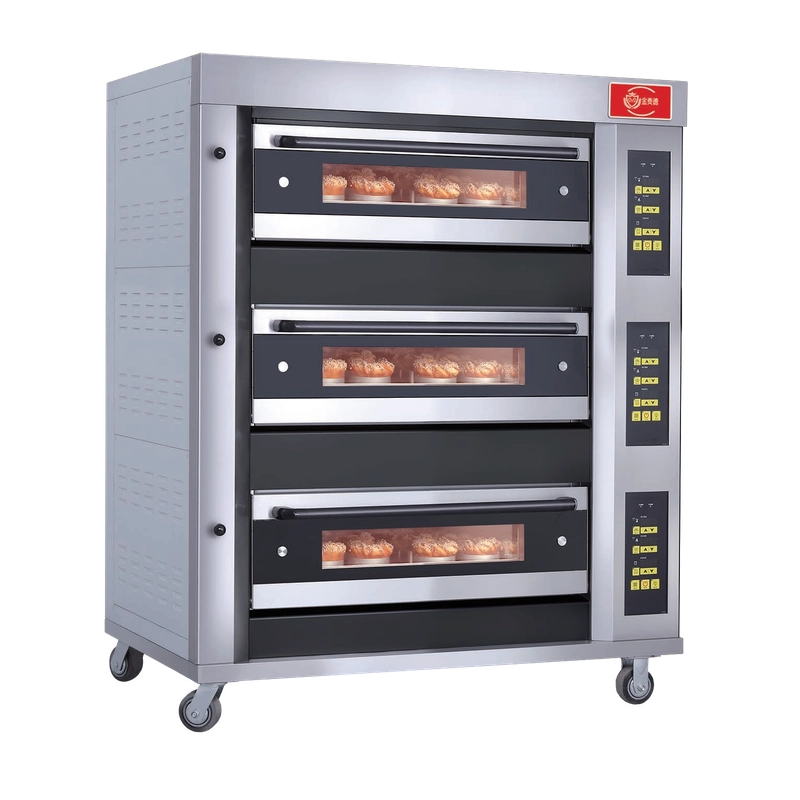
A multi-layer deck oven contains separate baking chambers.
Typical configurations include:
- One layer with two trays
- Two layers with four trays
- Three layers with six trays
- Three layers with nine trays
The advantage of independent layers is flexibility. A bakery may operate only one chamber during low-demand periods and use all chambers during peak production.
Separate layers may also allow different products to be baked at the same time, depending on chamber control and temperature requirements.
Consider Baking Time
Two products may use the same tray but require very different baking times.
Cookies may complete a cycle faster than large bread loaves. Therefore, the oven’s hourly capacity must be calculated according to the actual recipe.
Include:
- Preheating time
- Baking time
- Door opening time
- Loading and unloading time
- Recovery time between batches
Hot Air Oven Capacity
For a hot air circulation oven, airflow must remain unobstructed. Filling every tray too densely may reduce uniformity.
Theoretical tray capacity and practical loading capacity may therefore differ.
When testing a convection oven, evaluate:
- Color consistency between trays
- Baking speed
- Moisture loss
- Product shape
- Temperature recovery
- Fan performance
Rotary Oven Capacity
A rotary hot air circulation oven may use a rotating tray rack or rotary structure to improve heat exposure.
When selecting this type of oven, confirm:
- Number of trays
- Tray dimensions
- Rack dimensions
- Maximum loading weight
- Rotation system
- Installation clearance
- Door opening space
Rotary ovens may be suitable for bakeries requiring larger batch output and consistent tray-to-tray performance.
Allow for Future Growth
Buying equipment that only meets today’s maximum demand may create capacity problems later.
A reasonable capacity allowance may support:
- New product launches
- Additional retail customers
- Seasonal demand
- Wholesale orders
- Business expansion
- Unexpected production peaks
However, an excessively large oven may increase energy use and occupy unnecessary space.
Check Utility Requirements
Before ordering, verify:
- Voltage
- Frequency
- Phase
- Electrical power
- Gas type
- Gas pressure
- Ventilation
- Water connection
- Drainage
- Installation space
A high-capacity oven may require electrical upgrades or additional ventilation.
Capacity Information to Send the Supplier
To receive a suitable recommendation, provide:
- Product type
- Product weight
- Pieces per tray
- Tray dimensions
- Baking temperature
- Baking time
- Daily output target
- Operating hours
- Available voltage
- Gas availability
- Workshop dimensions
- Future expansion plan
A professional bakery oven manufacturer can use this information to recommend a more suitable model instead of simply offering the largest machine.