BLOG
Commercial Fryer with Filtration: How It Works and What to Check
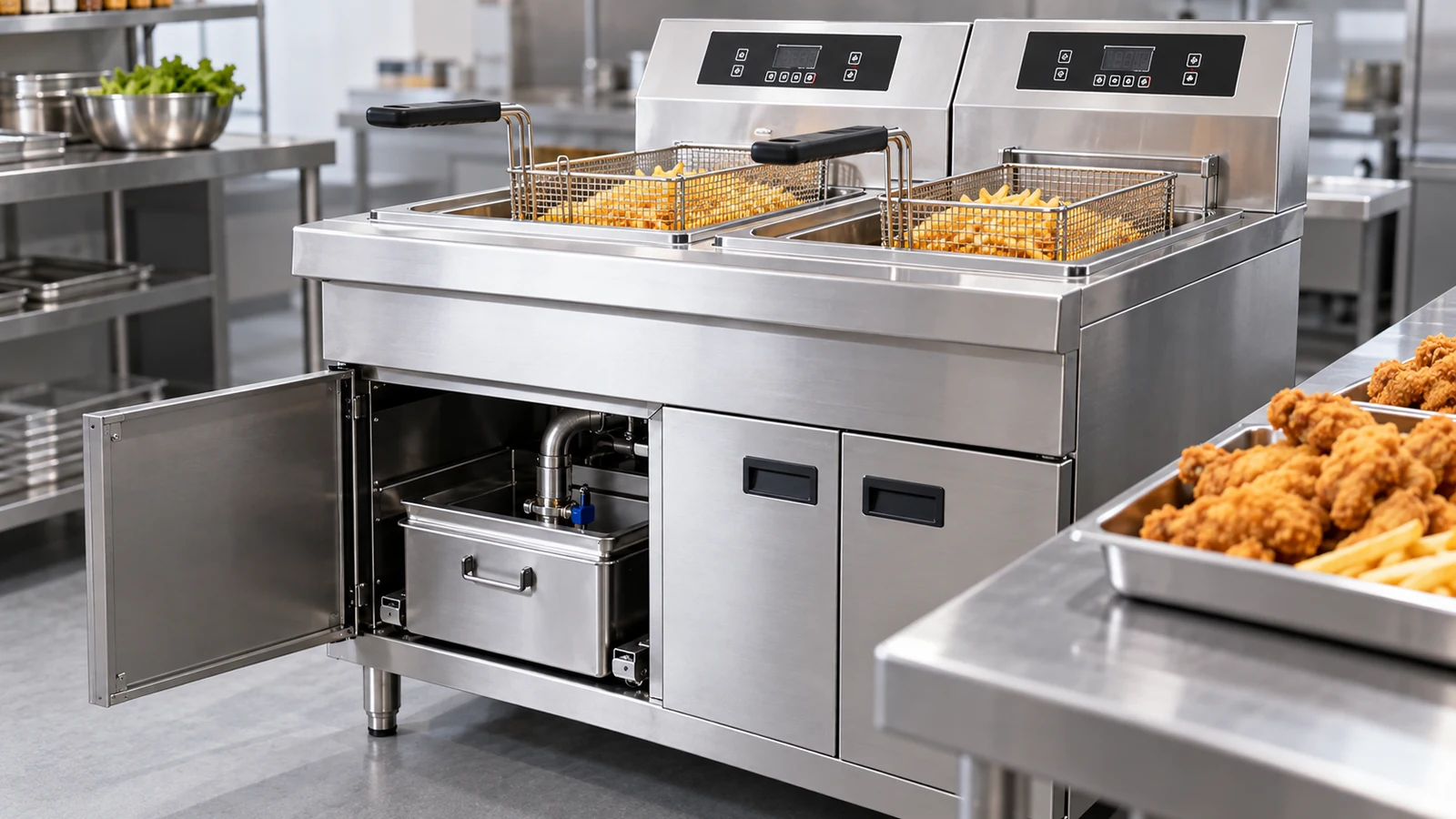
A commercial fryer with a built-in oil filtration system helps foodservice operators remove crumbs and some suspended particles from frying oil through a dedicated filtering process. It can support structured cleaning and oil management in restaurants, fast-food chains and central kitchens, but filtration does not restore chemically degraded oil or eliminate the need for oil-quality checks. Before buying, compare the frying method, oil-vat configuration, safe drain-and-return procedure, filtration consumables and actual menu workload. Jinmaid publishes filtration-equipped electric open fryers in its OFE range and gas pressure fryers in its PFG range. Their cooking processes and model-specific filtration arrangements are not interchangeable. Buyers should confirm the precise supplied components and operating instructions before ordering.
What Is a Commercial Fryer with a Filtration System?
A commercial fryer with a filtration system combines a frying appliance with an oil-filtering workflow designed to separate some food residue from the oil. For foodservice operators, the feature is relevant when a kitchen needs a repeatable method to manage crumbs across daily frying periods. It is not a claim that oil can be reused indefinitely. Buyers should evaluate the cooking method, installed filter configuration and authorized service procedure as a single equipment decision.
Jinmaid markets filtration-equipped electric open fryers and gas pressure fryers; the filtration feature should be verified for the exact model quoted, not inferred from a general category name.
How Does a Built-In Fryer Oil Filtration System Work?
A fryer filtration system is intended to separate oil from food residues collected during repeated frying. In a typical arrangement, an operator follows the equipment’s specified procedure to direct oil away from the frying vat, pass it through an appropriate filtering medium, and return or transfer it after filtration. The exact route may use a drain, receiving pan, filter material and pump; none of those components should be assumed for a particular fryer until its manual and parts list confirm them.
Why does this matter? Crumbs left in hot oil can continue to darken or burn, making routine particle removal relevant to daily oil management. However, filters differ in the particle sizes they capture and the way they are installed. “Built-in filtration” tells a buyer that filtration functionality is advertised; it does not tell them the filter medium, pump flow rate, cycle time or consumable replacement interval.
Jinmaid’s auto-lift electric open fryers page lists a built-in oil-filtering system and a sloping oil-pan-bottom design intended to assist drainage. The page identifies OFE-122, OFE-H122, OFE-124 and OFE-H124 configurations. These are open-fryer products: the introductory paragraph on the same page refers to pressure frying, so that conflicting sentence should not be used to reclassify the entire range.
| Equipment detail | Why it matters | What to verify |
|---|---|---|
| Oil drainage | Determines how oil reaches the filtering stage | Drain position, authorized operating temperature and sequence |
| Filter assembly | Retains particles within the system’s design limits | Filter material, spare parts and replacement procedure |
| Oil return | Determines when and how filtered oil re-enters service | Return route, interlocks and permitted restart conditions |
| Cleaning access | Affects the effort and downtime of routine maintenance | Which components the operator may remove and clean |
Why Does Fryer Oil Filtration Matter in Commercial Kitchens?
In high-turnover fast-food kitchens, chicken breading, batter and other crumbs can accumulate during service. Removing some suspended solids can support a documented oil-handling and cleaning routine and may reduce residue left circulating in the vat. The practical benefit depends on filter design, loading and correct operation. Claims about fixed oil savings, guaranteed food quality or extra operating days need controlled, model-specific evidence that is not provided in the public product descriptions.
What Can Filtration Remove—and What Can It Not Fix?
Oil filtration is not the same as oil renewal. A particle filter can trap crumbs and other solids that meet its capture characteristics. It cannot, simply by removing those particles, reverse chemical changes that have already occurred in the oil during heating and contact with food and moisture. Oxidation, hydrolysis and other degradation processes depend on operating conditions, food load, oil composition and time.
Therefore, a cleaner-looking vat is not proof that the oil remains suitable for use. Excessive foaming, persistent odors, discoloration or changes in food quality can prompt additional checks, but appearance alone is not a complete quality assessment. Operators should follow their applicable food-safety rules and the oil and fryer manufacturers’ instructions, including any required testing or disposal thresholds.
| Filtration may help with | Filtration alone cannot establish |
|---|---|
| Removing particles within the filter’s designed capability | That oxidized or otherwise degraded oil has been restored |
| Reducing residues available to remain in the oil | That a particular oil can be used for a guaranteed extra number of days |
| Supporting a documented cleaning routine | That routine oil-quality monitoring or replacement can stop |
Workflow Comparison: Built-In or Portable Oil Filtration
A built-in system is integrated into a compatible fryer arrangement. A portable filtration unit is a separate piece of equipment used according to its own instructions. Neither configuration is universally more effective: suitability depends on the kitchen layout, the number and type of vats, filter media, access for cleaning and whether transferring hot oil between equipment is permitted.
For a kitchen with multiple vats operating different foods, a buyer should trace each intended filtration route before selecting equipment. An integrated arrangement may avoid the need to move a separate unit to the fryer. A portable unit may be considered where several compatible fryers share one service process, but only if the oil-handling procedure is approved for that equipment and its operating conditions. Avoid calculating labor savings without a validated comparison of the actual workflow.
Ask who performs filtration, when it occurs, which tank is processed first, where spent filter material is discarded, and what happens if the drain or return cycle is interrupted. These operational questions are more useful than a simple “with filtration” checkbox.
Built-In vs Portable Commercial Fryer Oil Filtration
The relevant difference is workflow integration: a built-in system is part of a compatible fryer, while portable filtration uses separate equipment. When comparing them, map the physical oil-handling route, number of vats, operator access, approved filter media and training requirements. A separate unit is not automatically compatible with every fryer or oil-handling process.
Which Fryer Configuration Matches the Menu and Workload?
Open Fryers and Pressure Fryers Serve Different Cooking Processes
An open fryer operates without the pressure-cooking vessel used by a pressure fryer. Frying under pressure requires specific equipment, operating rules and safety safeguards. Filtration is a supporting feature, not a substitute for evaluating whether the intended foods should be prepared with an open or pressure frying process.
For example, Jinmaid’s gas pressure fryers page also lists built-in filtration. That does not mean its PFG series has the same drain assembly, consumables, maintenance sequence or cooking method as the OFE open-fryer series. The exact filtration configuration should be compared through model documents.
Oil Tank Capacity Is Not Food Output
Oil capacity measures the volume of oil a vat accommodates under its stated specifications. It does not tell a buyer how many portions the fryer can consistently produce per hour. Portion size, basket loading, recovery time, food type, required cooking cycle and operator availability all affect output.
As published for the OFE electric range, OFE-122 has two 11.5 L oil tanks and OFE-124 has four 11.5 L oil tanks. These figures describe those named configurations only; they do not establish a production rate or filtration cycle for the range as a whole.
| Published model | Oil tank arrangement | Operational question |
|---|---|---|
| OFE-122 | 2 × 11.5 L | Can two vats meet the menu and peak-period separation needs? |
| OFE-124 | 4 × 11.5 L | Does the kitchen have sufficient utilities, space and staff for four vats? |
| PFG-800 | 25 L listed for the gas pressure fryer | Is pressure frying required, and what are the model-specific operating rules? |
Jinmaid Commercial Fryer Models: What Do the Published Configurations Show?
Jinmaid’s published OFE-122 electric open fryer has two 11.5 L oil tanks; the OFE-124 has four 11.5 L tanks. The PFG-800 is a different gas pressure-frying configuration with a published 25 L oil-capacity figure. Tank volume is not an output-per-hour rating, and the availability of built-in filtration does not establish that these models share a filter medium, drain system or replacement parts.
For a multi-menu restaurant, begin with foods to be cooked and whether they require open frying or pressure frying. Next compare how many independent vats are useful for the menu, how staff perform filtration, and the site’s power or gas service. Request drawings and filter documentation for the final model before approval.
What Should Buyers Verify About the Filtration System?
The next step is to move from a website feature description to documents for the exact configuration being quoted. A supplier’s product page may identify the function, but a buyer still needs to establish which parts are supplied and how the system is operated.
- Confirm the model and cooking method. Specify electric open fryer or gas pressure fryer; do not assume filtration is identical across them.
- Obtain the filtering sequence. Review the operation manual for oil temperature limits, draining, filtration, return and safe restart.
- Identify consumables. Ask for the approved filter medium, spare-part identifiers, cleaning procedure and replacement conditions.
- Check the complete supply scope. Confirm the receiving pan, filtering components and any accessories are included in the selected quotation.
- Verify utilities and service space. Confirm electrical supply, gas supply where applicable, machine dimensions, ventilation and the clearance needed to service components.
- Review safety and responsibility. Establish which operations are permitted for trained kitchen staff and which require qualified service personnel.
Where the product page does not publish a filter rating, pump flow or consumable lifespan, leave that specification open until the model documentation supports it. Quoting a value from an unrelated brand would not make the purchasing decision more reliable.
How Should a Kitchen Manage Filtration and Oil Replacement?
A usable oil-management routine combines particle removal, periodic oil-quality evaluation, safe handling and documented replacement decisions. The filtration schedule should follow the fryer and oil suppliers’ directions, then account for the actual load: fine breading residue and heavily used vats may create different demands from lightly used equipment. No single number of filtering cycles is suitable for every menu.
Operators can record the vat, time of filtration, visible residue, filter-material change, oil-quality check and disposal decision. This provides a history that supports troubleshooting without pretending filtration has made the oil indefinitely reusable. If a filter path is obstructed, a return cycle behaves abnormally or the fryer displays an error, staff should stop the affected procedure and consult the correct instructions rather than improvising a hot-oil repair.
For buyers reviewing several equipment styles, Jinmaid’s commercial fryer category provides a starting point for the product range; the individual product pages remain the appropriate place to confirm advertised features.
Choosing a Filtration-Equipped Fryer: The Practical Decision
A commercial fryer with filtration makes sense when its cooking method fits the menu and its filter workflow fits the staff, kitchen space and oil-management procedures. Confirm the fryer type first, then compare vat layout, filter components, safe cleaning access, utilities and documented operating limits. Jinmaid lists both open and pressure fryer options with built-in filtration, but the specific configuration must be checked before ordering.
To discuss a specific setup, share your fryer requirements with Jinmaid—including the foods being cooked, vats required, peak service periods, available power or gas supply, kitchen dimensions and filtration-maintenance expectations.
Frequently Asked Questions
Does fryer oil filtration make used oil safe to keep indefinitely?
No. Filtration can remove food particles within the filter’s specified capability, but it cannot reverse oil oxidation or other chemical degradation. Oil must still be checked and replaced according to applicable rules and the fryer and oil suppliers’ instructions.
Can an electric open fryer and a pressure fryer use the same filtration procedure?
Not necessarily. The cooking method, drain layout, controls and approved filtering steps may differ by model. Use the specific operating manual and do not assume parts or procedures are interchangeable.
What should buyers ask about a built-in fryer oil filter?
Ask for the model-specific oil drain and return procedure, approved filter medium, spare-part identifiers, cleaning access, interlocks, utilities and the equipment included in the quotation.
How often should commercial fryer oil be filtered?
There is no universal interval. Filtering frequency depends on the manufacturer’s operating instructions, food residue, fryer load and kitchen procedures. Monitor oil condition separately; filtration does not replace oil-quality checks.